Lorem ipsum dolor sit amet, consetetur sadipscing elitr, sed diam nonumy eirmod.
Lorem ipsum dolor sit amet, consetetur sadipscing elitr, sed diam nonumy eirmod.

Alex
May 21, 2026

Event organisers can sell meaningful ticket volume before a lineup is complete when they sell the event’s culture, audience identity, access, and early-buyer advantage, rather than waiting for every artist, speaker, or attraction to be confirmed.
A lineup helps buyers justify a purchase, but it is not always the first thing they are buying. The NotebookLM research behind this article points to a larger pattern: people buy into culture, belonging, status, and the fear of missing a moment before they buy a tidy list of names.
One research source in the notebook described a platform-centric music ecosystem where social interaction had become a major commercial engine. The report noted that social networking accounted for 70% of Tencent Music Entertainment operating income, and it framed online social interaction as a RMB 37.37 billion market. That data is China-specific, but the lesson for organisers is broader: attention becomes purchase intent when people feel part of a visible community.
For an event team, the practical takeaway is not “copy China”. It is that pre-lineup selling works best when the campaign gives buyers something socially meaningful to join. A buyer can wait for the full programme if the offer is only a list of performers. They are more likely to act early if the event already signals a tribe, a scene, a venue experience, and a limited place inside that room.
Sell the promise in plain language, using marketing hooks and angles that match the audience instead of hiding the missing lineup. Who is it for? What will it feel like? Why will people talk about it afterwards? Why is buying now safer than waiting?
The notebook report repeatedly returned to youth-led, social-first demand. It cited “Post-90s” and “Post-00s” consumers as 90% of May 1st live-performance spending in the analysed market, with “Post-00s” growing from under 6% to 18% between 2019 and 2021. Those figures should not be pasted blindly into every local market, but they do underline a useful point: younger buyers often respond to signals of identity, novelty, and participation before they have a complete rational checklist.
That means the campaign needs proof before names. Past-event video shows the room has energy. Venue imagery makes the event feel real. Community language tells buyers who else is likely to be there. Clear release dates show that more value is coming. A visible ticket tier shows that waiting has a cost.
| Pre-lineup asset | What it proves | How to use it |
|---|---|---|
| Past-event video | The room has energy | Put it above the fold and in retargeting |
| Venue or setting | The event is real | Show capacity, location, access, and atmosphere |
| Audience cues | People like me attend | Use testimonials, UGC, crew lists, and community language |
| Tiered pricing | Waiting has a cost | Show allocations and price movement before release dates |
| Update cadence | More value is coming | Tell buyers when each reveal will land |
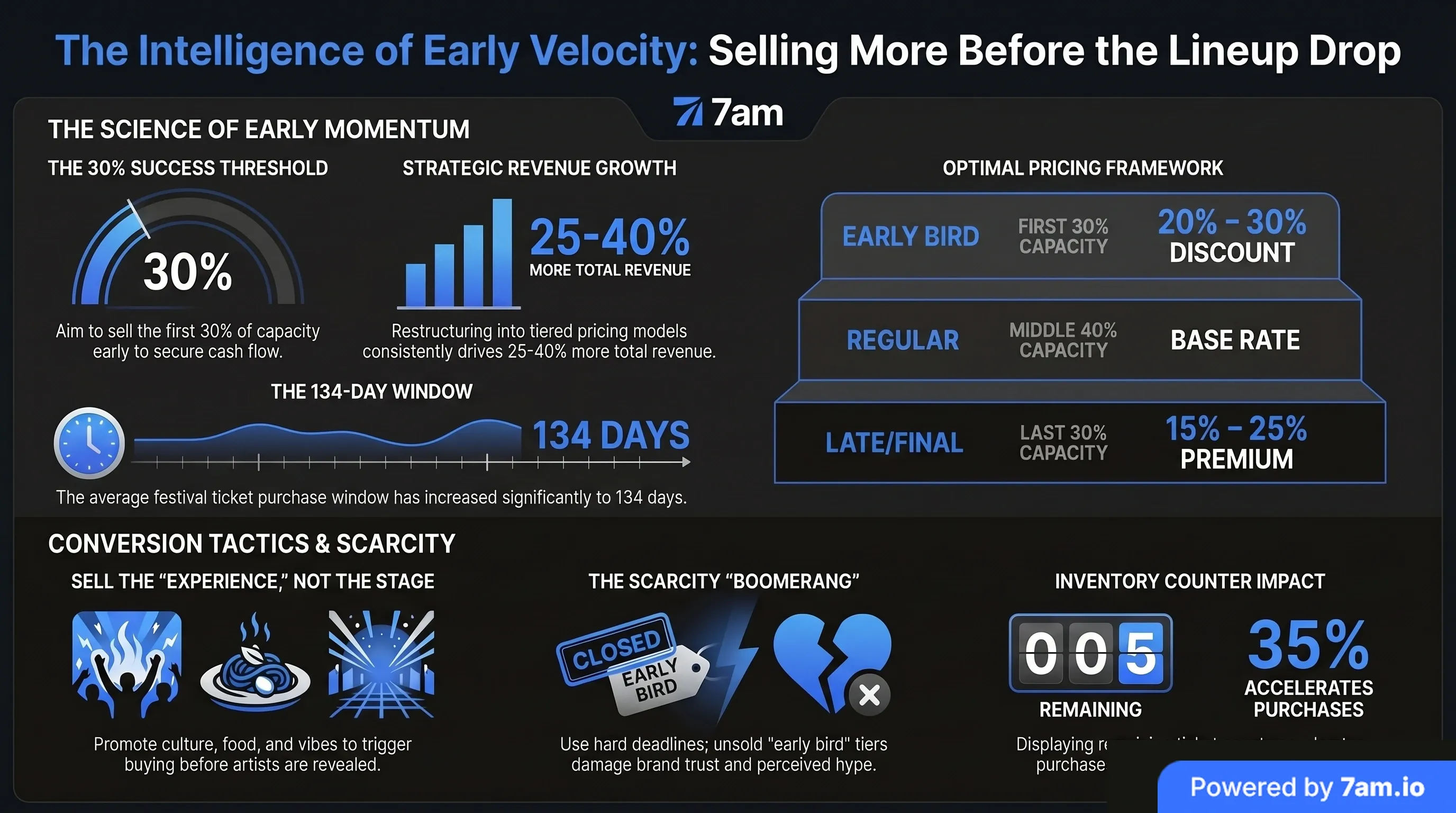
Early pricing should reward trust, not apologise for an incomplete campaign. A useful structure is simple: founder or first-release tickets for the earliest believers, a second release when proof increases, and a final release once the full programme is public.
The notebook’s source list included material on early-bird pricing, tiered releases, loyalty presales, and festival ticket strategy. The common operating idea is that early tiers work when they are transparent. Buyers should understand what is limited, when the price changes, and what extra confidence they will receive before the next release.
The mistake is vague urgency. Buyers can sense when scarcity is fake. Better to show the real allocation, the real price movement, and the real reason to buy now. If only 200 founder tickets exist, say that. If the next artist reveal happens on Friday, say that. If early buyers get first access to add-ons, afterparties, VIP upgrades, or group bundles, make the value clear.
This also protects the brand. A rushed “cheap tickets now” message can train buyers to wait for discounts. A clear “first believers get first access” message positions early purchase as status. The difference matters, especially when the full lineup is not yet available to do the heavy lifting.
The NotebookLM report described a market shift from a record-label-centric model toward digital platforms acting as a central node. It also described fan economy behaviour, online karaoke, livehouses, music IP, and subcultural discovery as important parts of demand. For event organisers, the lesson is not about one country or one platform. It is about where trust forms before purchase.
If trust forms inside communities, then the campaign needs community mechanics. That can mean loyalty presales for previous attendees, a waitlist for people who want first access, creator or partner codes that reveal which micro-audiences are moving, and segmented messages for different buyer groups. A generic announcement may underperform because it asks everyone to care about the same incomplete promise.
The report also warned against relying too heavily on individual celebrity momentum. It referenced controversy around celebrity-led variety shows and argued that IP, story, and culture can outlast a single star. That is useful for pre-lineup sales. If the whole campaign depends on one yet-to-be-announced name, the organiser has little to sell until that name is ready. If the campaign sells the world of the event, the lineup becomes an accelerant rather than the entire engine.
Track landing-page visits, ticket purchase experience signals, completed purchases, abandoned checkouts, campaign source, repeat buyers, group orders, and waitlist sign-ups. Those numbers show whether the event has an offer problem, a trust problem, or a checkout problem.
A practical weekly review should be short. Which audience is clicking? Which source is creating checkout starts? Which buyers abandon on mobile? Which previous attendees are returning? Which message creates paid intent rather than only likes? If the event is getting traffic but few checkout starts, the promise may be unclear. If checkout starts are strong but completion is weak, the purchase path may need repair before more ad spend is added.
This is where checkout abandonment becomes especially important. Pre-lineup buyers already carry uncertainty. Any friction in fees, mobile forms, payment options, or trust signals can turn that uncertainty into a lost sale. The campaign should not only create demand. It should remove reasons for warm buyers to postpone the decision.
Attendee data ownership lets organisers build momentum in layers. The first buyers can be segmented, thanked, retargeted, and used to shape the next message. When the lineup or programme expands, the organiser can return to warm demand instead of starting again from cold social reach.
The notebook research emphasised platform power: the organisations that control the audience relationship can see demand forming earlier. That is directly relevant to ticketing. If sales data, abandoned checkouts, customer tags, and campaign attribution sit inside tools the organiser cannot properly use, every reveal becomes less efficient. If the organiser owns the data, each new announcement can be aimed at people who have already shown intent.
7am Tickets should stay practical here. The platform is useful when it helps organisers see early buyer intent, recover missed sales, understand which channels are converting, and keep the audience relationship connected to the event team. Pre-lineup selling is not a guessing game when the data shows which communities are already leaning in.
Start with the world of the event: audience, venue, format, date, and the reason it matters now. Then sell a limited first release to the warmest audience: previous buyers, waitlist members, partners, and community insiders. After that, add proof in layers. Show the room. Show demand. Show the next reveal date. Show the price movement.
The full lineup should arrive as one of several momentum moments, not the first believable piece of the campaign. If the event has already sold the culture, the lineup announcement confirms the buyer’s decision and gives them a reason to share. If the campaign has been silent until the lineup is ready, the organiser has to create awareness, trust, urgency, and conversion all at once.
Do not wait for the full lineup to start selling the event. The notebook research points to a clear operating principle: demand can form around culture, community, scarcity, and social proof before every detail is confirmed. Sell the promise, prove the room, reward early trust, and use ticketing data to learn which audience is ready before the reveal.
Explore More
View All