Lorem ipsum dolor sit amet, consetetur sadipscing elitr, sed diam nonumy eirmod.
Lorem ipsum dolor sit amet, consetetur sadipscing elitr, sed diam nonumy eirmod.

Alex
Jul 14, 2026
Bad bots now make up close to 40% of all ticketing traffic, by Imperva's count, and on a hot onsale they can be more than 80%. That means for every real fan in the queue, there can be four automated buyers ahead of them, sweeping inventory to flip on a resale site.
The fan sees the outcome, not the cause. Tickets "sold out" in ninety seconds, then reappeared at triple the price on a secondary marketplace. To the buyer, that looks like the platform failed them. It usually did.
This isn't abstract. Patrick FitzGerald, who runs eCommerce operations for the Pittsburgh Cultural Trust, put it plainly: every time a big event goes on sale, they see huge traffic spikes that aren't real patrons, but automated resellers trying to buy tickets and sell them at inflated prices. That's the daily reality on the operator side.
This is the part that should interest anyone launching a ticketing brand. The incumbents have lived with this for years because their scale makes them the target and their contracts make them hard to leave. A new operator gets to design for it from day one. Fair access isn't a feature you bolt on later. It's the thing you can build your whole brand around.
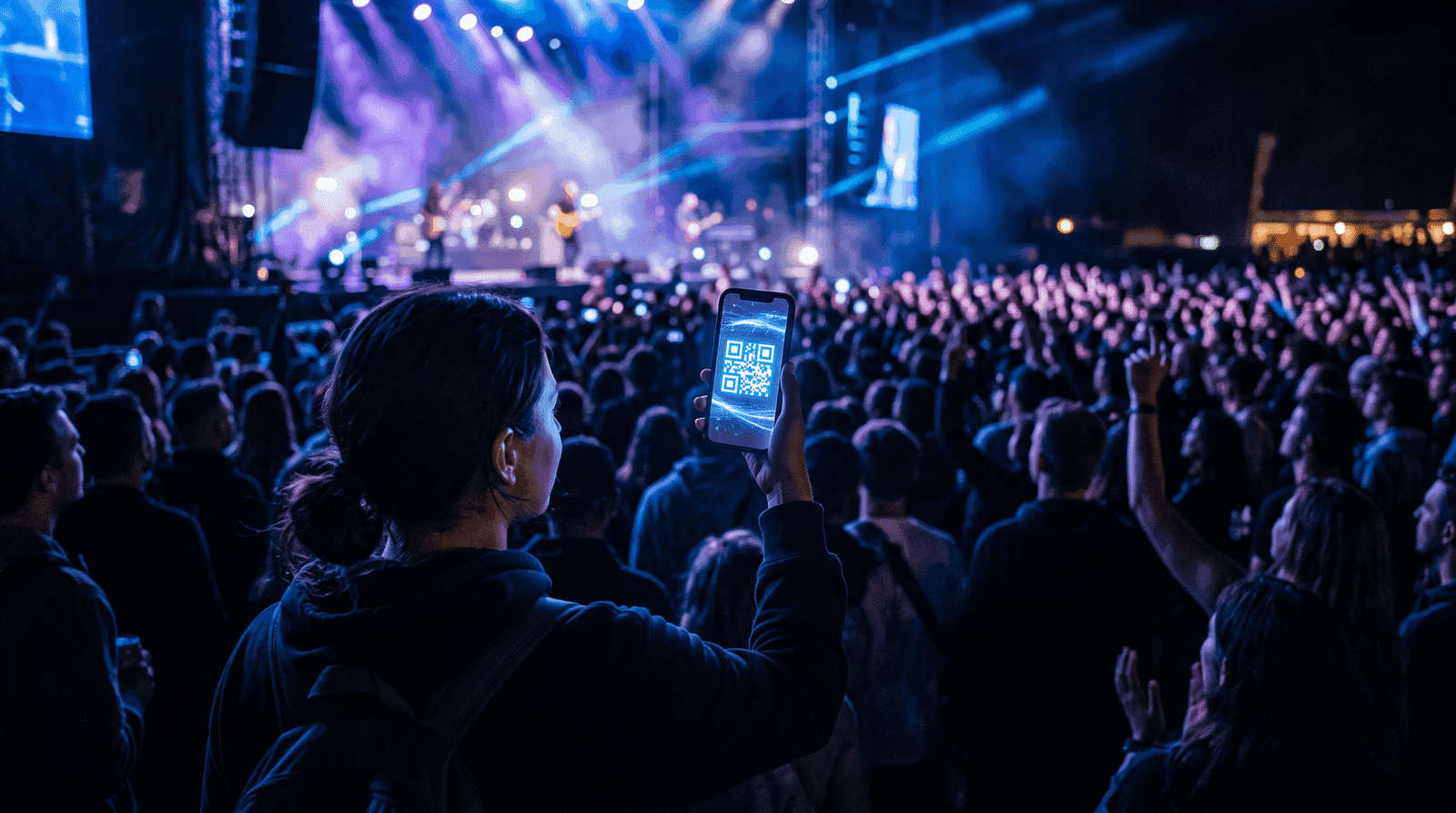
DICE is the proof. It charges fans no booking fee, takes 8-10% from promoters instead, and locks every ticket to an activated mobile QR that only comes alive near showtime. That one design choice makes resale on third-party sites almost pointless. DICE didn't win by being cheaper on paper. It won by being the platform fans trust to get them in at the price on the ticket.
Yes, and fairness is the stronger position. You cannot out-spend Ticketmaster. You can out-trust it.
Price is a race you lose. The incumbents have volume, so they can always match a headline rate, and a war over booking fees just trains buyers to shop on cost. Trust compounds the other way. A promoter who watches their fans get through an onsale clean, at face value, without a bot wall, remembers who delivered that. So does the fan.
Think about who actually chooses your platform. It's the promoter, the venue, or the festival deciding where their audience will buy. They are judged by their fans on how the onsale felt. Give them an onsale that feels fair and you've handed them a story they'll tell their whole roster, the kind of proof that helps them build a genuinely must-attend reputation.
There's a reason the fans-first platforms grew fastest in the last five years. DICE, and the model it proved, showed that "we protect real buyers" is a brand people repeat for free. Compare that to dynamic pricing, which turns fans against the event the moment they feel gouged. Fairness and gouging are the two doors. A new brand gets to pick.
Fair access is a stack of controls that keep tickets in the hands of real buyers, from the moment of onsale to the moment of entry. It is not one anti-bot button.
Here's what the stack looks like in practice:
7am delivers this layer as platform features: identity-linked limits, controlled resale, mobile tickets, smoother scanning at the gate, and real-time reporting so an organiser can see the queue behaving in front of them. Notice what's missing from that list: a promise that some black-box AI blocks every bot. No honest ticketing platform should sell that. The controls above are what actually move the number, and they're the ones you own.
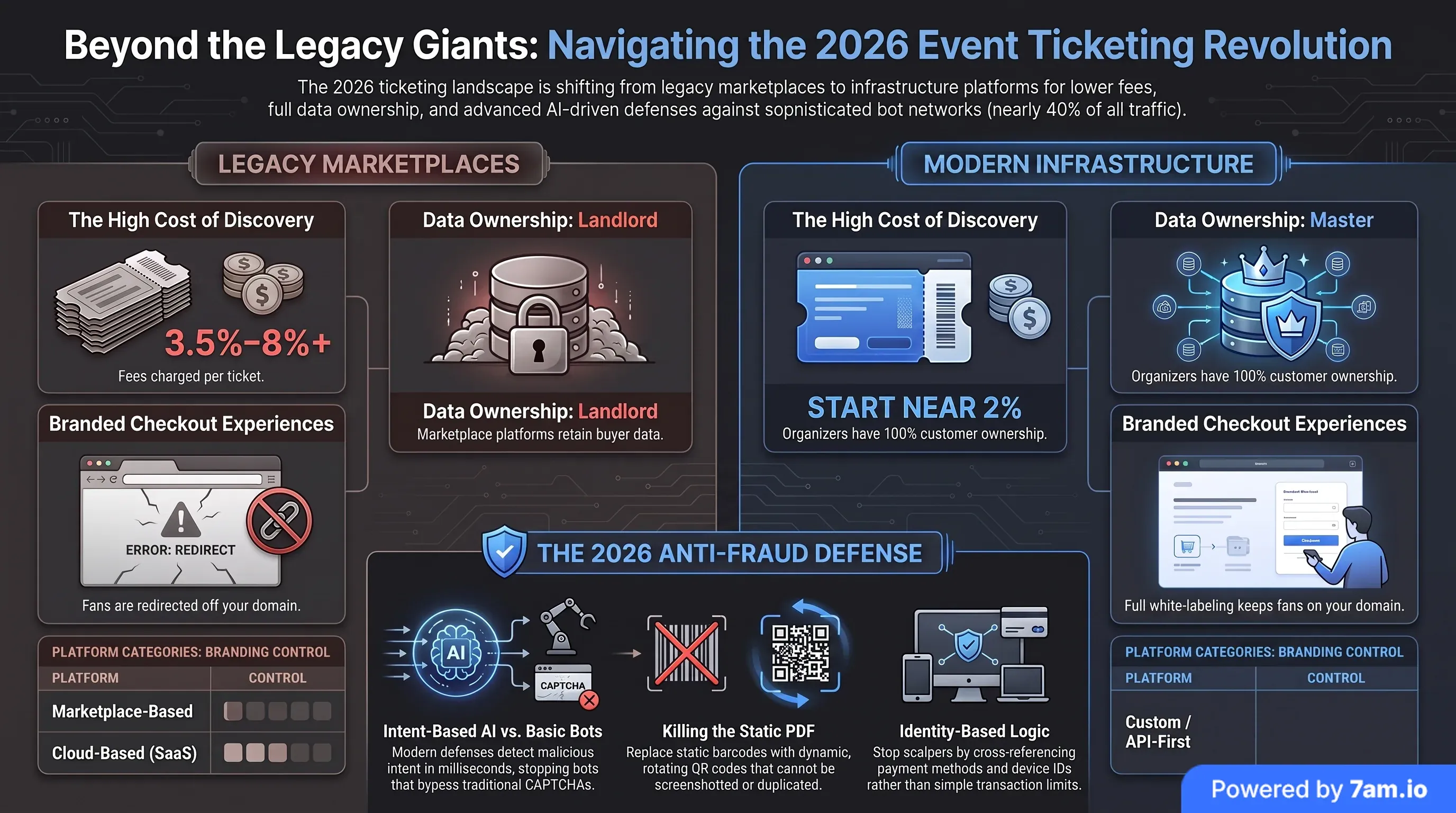
You lean on design, not on a war room. Most of the defense is architectural, and a good platform ships it for you.
Modern bots mimic humans well enough that a basic CAPTCHA or an IP block barely slows them. Blocking one IP does nothing when the attacker has ten thousand. So the winning move isn't to out-code the bots in real time. It's to make a scalped ticket worthless. Identity-linked purchase, a late-activating mobile QR, and transfer locks mean that even a ticket a bot manages to buy can't be resold at a profit. Take the profit out and the bots leave on their own.
For the biggest onsales, a stadium show or a World Cup fixture, some operators layer a specialist bot-mitigation vendor like DataDome or Prosopo on top of the platform. That's a real tool, and it's honest to name it as a separate layer rather than pretend the ticketing platform does it invisibly. But for the regional promoter or the vertical brand that makes up most of a new operator's roster, the platform-level controls carry the load. You don't need a fraud team. You need a platform that was built to survive the onsale and a resale policy that gives scalpers nothing to sell.
Regulators are pushing the same direction. South Korea expanded its anti-scalping law on 29 January 2026 to target the conduct that lets bots resell for profit, and several markets are moving to ban resale above face value and put the verification burden on the seller. Build fair access in now and you're ahead of the rule instead of scrambling to meet it.
Allow it, but own it. Banning resale outright just sends the trade to StubHub and the Facebook groups, where you lose the data and the fan pays the markup anyway.
The controlled version is an official fan-to-fan exchange capped at face value. A buyer who genuinely can't go lists inside your platform, another fan buys it at the printed price, the ticket transfers cleanly, and the scalper's markup never happens. You keep the record of who holds every ticket, which matters for both fraud and for owning the customer relationship rather than renting it back from a marketplace. Organisations that bring resale in-house typically recover 15-20% of the secondary-market fees they used to leak.
Resale is also where fairness becomes a promoter benefit, not just a fan one. An artist who hates seeing their fans fleeced can point to your capped exchange as the reason they moved. That's a signing argument. It's the kind of control a brand-conscious operator uses to keep the audience relationship in their own name instead of handing it to a reseller.
It gives you a promise the incumbents can't make with a straight face. "Real fans, real prices, no bots" lands because everyone has been burned by the opposite.
The DICE playbook is worth copying here. Zero booking fees to fans, funded by a promoter-side rate, plus the anti-scalping tech, became the entire brand identity. Fans downloaded it because it felt like it was on their side. For a new operator that's the cheapest growth you'll ever get: a differentiator that fans repeat to each other without you paying for the reach.
Fold it into how you sell. When you pitch a venue or a festival, don't lead with your fee. Lead with the onsale they'll get and the resale they'll control. Fairness is easier to defend than a price, and it protects your margin, because you're not competing on the fee that funds your business. Set your fair-access story as the headline, and let the hard product checklist do the rational reassurance underneath it.
There's a limit worth naming. Fairness only sells if you deliver it. Promise a bot-free onsale and then fall over at 50,000 concurrent buyers and you've built the opposite brand, fast. The story and the engineering are the same investment. You can't market one without the other.
The data explains why fair access is a live commercial issue, not a nice-to-have. Bots are a big share of traffic, resale markups are steep, and fraud losses run into the billions.
| Metric | Figure | Source |
|---|---|---|
| Bot share of ticketing traffic | Nearly 40% | Imperva, 2025 |
| Bot share during a high-demand onsale | Over 80% | Industry reports, 2026 |
| Advanced bots that slip past WAFs and rate-limiting | 93% | DataDome Global Bot Security Report, 2025 |
| Typical scalper resale markup | 200-500% (up to 4x face value) | Prosopo, 2026 |
| US ticket-fraud losses to consumers | Over $12.5 billion | 2024 |
| Secondary-market fees recovered by bringing resale in-house | 15-20% | vivenu, 2026 |
| DICE promoter-side rate (zero fan booking fee) | 8-10% | DICE model |
Read the table as one argument. Bots are everywhere, the markup they extract is huge, and the operator who closes that gap keeps money that currently leaks to scalpers and secondary marketplaces.
Bots own up to 40% of ticketing traffic, and that's the opening. A new ticketing brand can't win a price war with Ticketmaster, but it can win the trust war by making fair access the core of the product and the pitch: identity-linked limits, late-activating mobile tickets, controlled resale, and clean scanning. Get the fairness engineering right and it becomes the marketing for free. That's the wedge, and right now the incumbents can't follow you through it.
Explore More
View All