
Lorem ipsum dolor sit amet, consetetur sadipscing elitr, sed diam nonumy eirmod.
Lorem ipsum dolor sit amet, consetetur sadipscing elitr, sed diam nonumy eirmod.

Sarah
Jun 15, 2026

Open ten white-label ticketing websites and the pricing pages blur together. Custom branding, your own domain, low fees, full control. Every vendor says the same five things. There are around 892 white-label ticketing startups now, 140 of them funded, and most of the content ranking for this topic is a listicle written by one of them. So the honest version is worth writing down.
This guide is the nine questions that actually separate a platform you own from a platform that lets you paste your logo on top. Some of these you will not find on a sales page, because the answer is awkward. Run a prospective vendor through all nine before you sign anything. If you are still earlier in the decision and weighing whether to build your own platform or white-label one, start there first, then come back to this.
This is the one question that reveals everything else. If buyers complete payment on your own domain under your brand, you have real ownership. If they get redirected to the vendor's domain at checkout, you are renting.
Watch what happens at the exact moment money changes hands. A lot of "white-label" platforms brand the event page beautifully, then bounce the buyer to checkout.vendorname.com to actually pay. Your punter sees a different company's name on the most important screen in the whole flow, the one where they hand over a card. That break tells you the platform is a hosted storefront with a paint job, not infrastructure you control.
Keep the checkout on the org's own domain and three good things follow at once. Pricing transparency improves, because you set and see the full fee. Post-purchase support stays yours, because the confirmation email comes from you. And the trust signal holds, because a Whakatāne venue selling to locals does not suddenly look like it outsourced to a faceless platform. If a vendor cannot put the checkout on your domain, the rest of their branding promises are decoration. This is also how you avoid losing your brand the moment you start selling tickets online.
Real white-label removes the vendor entirely. Logos, fonts, colours, custom domain, email templates, confirmation messages, and the checkout. Shallow white-label lets you change a logo and an accent colour, then leaves fingerprints everywhere else.
The gap between those two is where buyers get caught. Ask to see a live client running the platform and look for the vendor's name in the footer, the URL bar, the booking confirmation email, the refund email, and the "powered by" line nobody mentions in the demo. One NZ promoter I spoke to found the platform's brand sitting in the calendar invite that went to every single ticket-holder, which is not a place you can easily edit.
The deeper question underneath this is control. A platform that removes its presence completely is telling you it makes money from your success, not from harvesting visibility off your events. A platform that keeps its logo in twelve places is advertising to your audience on your dime.
You should own it outright, with full export rights, and the vendor should have no licence to market to your buyers. Many platforms quietly co-own that data, which means the people you spent money acquiring become the vendor's audience too.
This is the part that should make you angry if you read the terms closely. Eventbrite's data co-ownership policy lets it market competing events to the same customers you brought to the platform. You pay to acquire a buyer for your festival, and the platform can turn around and put a rival event in front of them. Your attendee data is worth more than your lineup, and a co-ownership clause hands half of that asset to the company you are paying.
Owned data compounds. It is the email list you remarket to for next year, the lookalike audience that drops your Facebook cost per acquisition, and the proof you show a sponsor. Organisers who own their data can turn ticketing numbers into sponsor-ready proof instead of starting every campaign from zero. Ask one blunt question: can the vendor contact my ticket-buyers for any reason, ever? If the answer is anything but a flat no, the data is not really yours.
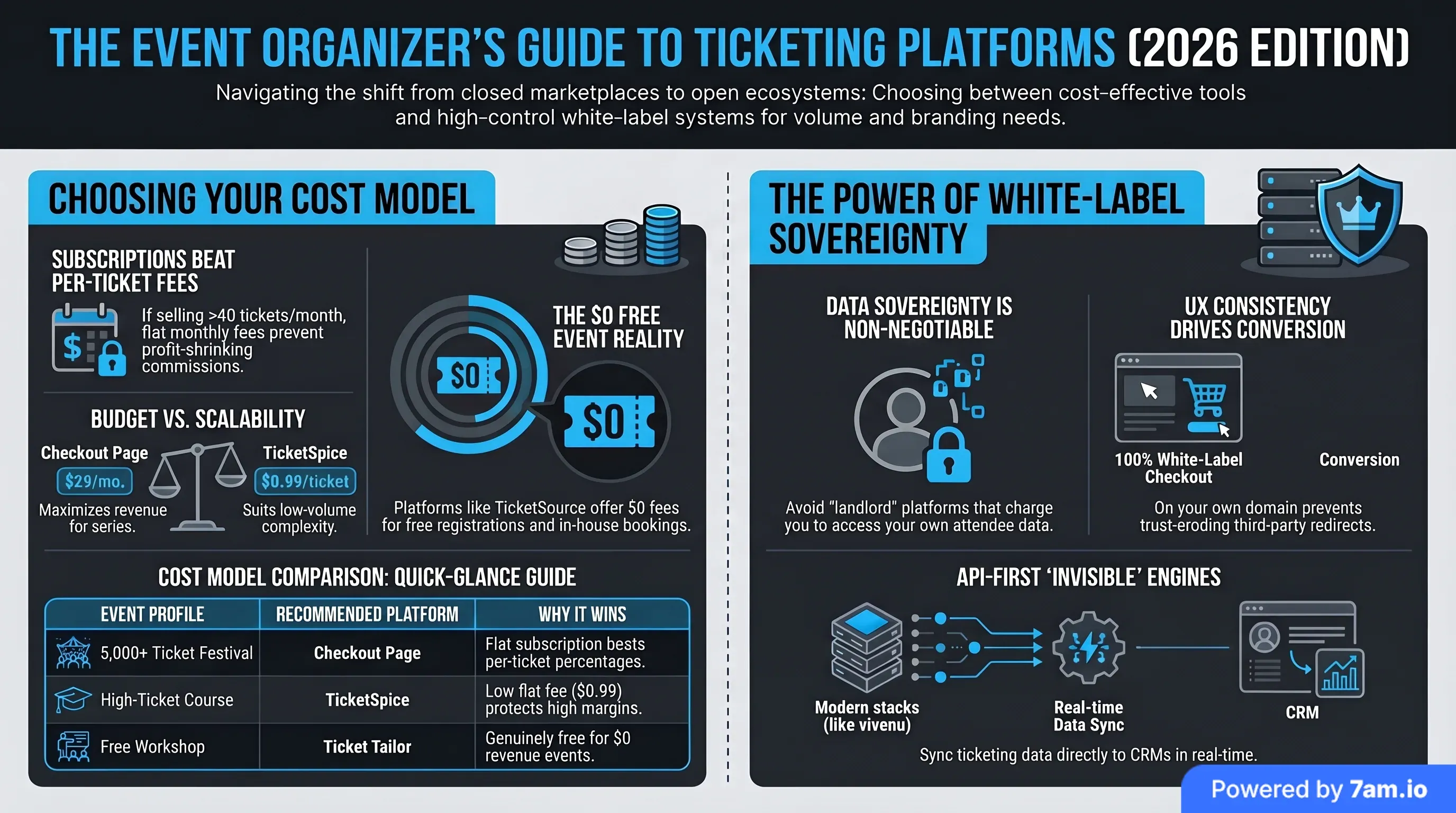
You want to set your own booking fee and keep the margin. A real white-label platform charges you a wholesale rate and lets you price the fee to your customer however you like, so the spread is your revenue.
This is the whole business model for a platform operator, so do not let it get glossed over. The reason event businesses move off Ticketmaster and Eventbrite is that incumbents take 27 to 31% in booking fees, and a 2026 antitrust jury found Ticketmaster overcharged $1.72 per ticket on top. When you run your own branded platform, that fee stops being a cost you absorb and becomes a margin you control. The unit economics of running a ticketing company live or die on this number.
Check three things. Can you set different fees for different events or clients? Does the fee show as your line item or the vendor's? And can you run an absorbed-fee model for a charity gig and a passed-on-fee model for a commercial show, on the same account? Rigid fee structures are how you stop ticketing fees from quietly eating your profit only to find the platform took the flexibility instead.
The right answer is fast, predictable, and ideally before the event. Slow payouts are a cash-flow tax that platforms rarely advertise, because the float sitting in their account is working for them, not you.
Many platforms hold your ticket revenue until after the event clears, sometimes a week or more past the door. That timing decides whether you can pay the headline act's deposit, the venue bond, and the production invoice without dipping into your own pocket. Slow ticket payments hold events back in a way that no fee comparison captures.
Look at the payment rails underneath. A platform built on Stripe or Afterpay can usually offer faster, scheduled payouts and clear timing, rather than a vague "funds released after the event." Ask the specific question organisers should always ask: do I get paid instantly when a ticket sells, or do you hold it? The gap between those two answers is real money on a $200,000 onsale.
This is the question that gets skipped until the day it matters, and then it is the only question. A platform that buckles when demand spikes will cost you more in one bad onsale than any booking fee saves you across a year.
High-demand onsales are one of the hardest problems in consumer software. FIFA's 2026 World Cup ticketing crashed publicly and took heat across social media for it. The failure pattern is always the same: buyers see seats as available, click to buy, then lose them at checkout, or the same ticket shows as available on a phone and sold out on a laptop. Underneath that is a system whose request volume blew past its capacity. One technical detail matters here. Many cheaper platforms calculate fees only at the cart stage to save compute, and the moment they move that calculation to the high-traffic front end, the database load multiplies and becomes a single point of failure.
Real infrastructure handles this with cloud auto-scaling, load balancing, a virtual queue, and asynchronous checkout that keeps the page alive even during a sold-out surge. A homegrown build almost never has these on day one, which is the quiet reason "just build it yourself" stories end badly. Treat onsale reliability the way you treat checkout abandonment, as a direct revenue leak, not a technical footnote.
Migration cuts both ways, and you should ask about both directions before you commit. Getting your historical orders, your seating maps, and your customer list into the new platform should be supported, not a do-it-yourself export project. Getting them back out later should be possible at all.
Vendors love to talk about onboarding and go quiet about offboarding. The lock-in trick is simple. Make your customer data and order history hard to extract, and switching platforms becomes a rebuild you will never start. Ask for the export format, ask whether migration of past events is a service they provide, and ask what you walk away with if you leave. A vendor that treats you as a true partner offers real migration support in both directions. One that treats you as captured revenue makes the exit expensive on purpose.
There is a timing trap too. You cannot cut over to a new platform in the middle of an active onsale cycle, so the migration has to thread between your events. Misjudge that window and you turn a routine switch into one of the ticketing mistakes that cost organisers hundreds of thousands.
Look past the headline rate at how the cost behaves as you grow. A percentage-per-ticket model gets more expensive every time you raise your ticket price, even though your cost to sell that ticket did not change. A flat per-ticket fee or a subscription stays put.
Do the maths on your real numbers. Eventbrite charges 3.7% plus $1.79 per ticket, so a $100 ticket costs $5.49 in platform fees and a $250 ticket costs $11.04, for the exact same transaction. A flat model like $0.85 a ticket does not move when your price does. Across a season of higher-priced shows, subscription pricing delivers roughly 33% better total cost of ownership, with the bonus that your fee is predictable enough to budget around.
Total cost of ownership is not the lowest single number. It is the fee model, the payout timing, the data you keep, and the brand control, priced together. A platform that is 0.4% cheaper per ticket but co-owns your data and bounces your checkout is more expensive in every way that compounds. This is the same discipline behind choosing the right ticketing system in the first place, scaled up to a platform you intend to run as a business.
The last question is the one that frames all the others. A genuine white-label partner makes money when you make money and stays out of your way. A platform dressed as a partner uses your events to build its own audience, its own data asset, and sometimes its own competing marketplace.
You can usually tell from the answers to the first eight questions. Vendor-domain checkout, co-owned data, rigid fees, and a hard exit all point the same way. So does a platform that runs a public consumer marketplace alongside its white-label product, because every buyer you bring becomes a name in their directory. Decide what you actually need, too. Some buyers ask for a public API or an embeddable widget when what they really need is branded hosted pages on their own domain, full data ownership, flexible fees, fast payouts, and a platform that holds up at onsale. Be honest about the requirement, then test the vendor against the real one.
The deliverable features worth confirming are concrete: custom-branded pages on your own domain, multi-tenant accounts if you serve several organisers, flexible booking-fee splits, Stripe or Afterpay payouts, seating plans, resale and ticket-swapping, scanning and access control, staff permissions, and real-time reporting. If the vendor passes all nine questions, you are not buying software. You are buying a ticketing operation you actually own.
Run every vendor through the same scorecard. The left column is the question, the middle is what a real white-label answer sounds like, and the right is the tell that you are renting a logo. A platform that lands in the right-hand column on checkout, data, and reliability is the one to walk away from.
| Question to ask the vendor | Signals real ownership | Signals you are renting |
|---|---|---|
| Where does the checkout live? | Buyer pays on your own domain | Redirect to the vendors domain at payment |
| How deep does the branding go? | No vendor name anywhere, including emails and invites | Vendor logo in footer, URL, or confirmation email |
| Who owns the customer data? | You own 100% with full export rights | Vendor co-owns and can contact your buyers |
| How flexible is the booking-fee split? | You set the fee per event and keep the margin | Fixed fee shown as the vendors line item |
| How fast do payouts clear? | Fast, scheduled, often before the event | Held until a week or more after the event |
| What happens at onsale surge? | Auto-scaling, queue, async checkout, proven at load | No load story, fees calculated at the front end |
| How does migration work? | Supported export and import, both directions | Hard to export; offboarding is a rebuild |
| What does the pricing do at scale? | Flat or subscription, predictable as you grow | Percentage of price that climbs with ticket value |
| Partner or competitor? | Makes money when you do, no public marketplace | Runs a marketplace that lists your buyers |
The nine questions collapse into one principle: real white-label means you own the brand, the data, the margin, and the relationship, while the technology stays invisible. Where the checkout lives is the fastest way to find out, because a vendor-domain checkout almost always travels with co-owned data, rigid fees, and a hard exit. Score every platform on all nine before you sign, weight ownership and reliability over a half-percent fee difference, and you will pick a platform you can build a business on rather than rent space inside. That is the whole point of running your own ticketing brand, and it is exactly what 7am is built to put under it.
Explore More
View All