Lorem ipsum dolor sit amet, consetetur sadipscing elitr, sed diam nonumy eirmod.
Lorem ipsum dolor sit amet, consetetur sadipscing elitr, sed diam nonumy eirmod.

Valentin
Jun 10, 2026
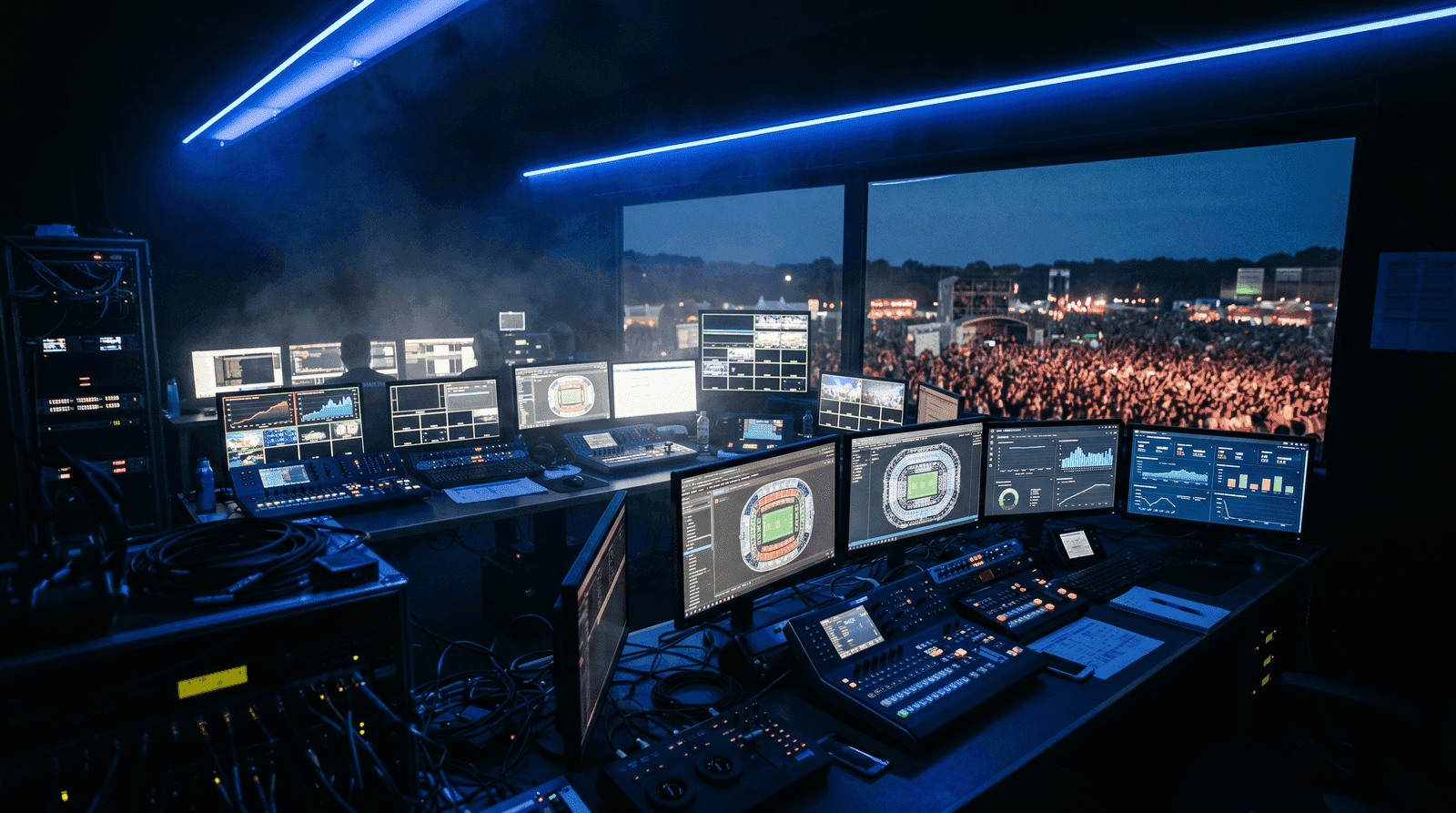
The real question is not "can we build it." Almost anyone can build a ticketing page. The question is whether ticketing technology is your product, or just the road your customers walk down to reach your product.
A live music promoter selling 4,000 tickets a month does not need to own a payments stack. A SaaS company whose whole pitch is "ticketing for community theatres" does. Same software on the surface. Completely different decision underneath.
The event businesses that structure profitable operations around their core strength, not their infrastructure, are the ones that scale. Owning a payments stack is not a core strength unless payments is your product.
Get this wrong in the exciting direction and you spend a year and a quarter of a million dollars building infrastructure that three other companies already sell you for a revenue share. Get it wrong in the cautious direction and you hand your core IP, and your margin, to a vendor you now depend on. So the honest first move is to write down one sentence: is ticketing the thing we sell, or the thing we sell through? Everything else follows from that.
A custom ticketing MVP costs $80,000 to $120,000 and takes around 18 to 20 weeks of build time in 2026. A feature-rich, enterprise-grade platform with a custom backend runs past $500,000 and 9 to 12 months.
Those are not napkin numbers. A Tier 2 custom build that cost $120,000 over 28 weeks in 2022 now lands at roughly $80,000 to $95,000 over 18 to 20 weeks, because AI-assisted development has compressed the front end of the work. Good news. It has not compressed the hard part, which is the backend that moves money and the compliance that keeps you out of trouble.
Then there is the bill that arrives after launch and never stops. Maintenance and support typically run 15 to 20% of the original build cost every year. Build a $120,000 platform and you are signing up for $18,000 to $24,000 a year just to keep the lights on, patch the security holes, and stay current with payment rules. Hosting scales on top of that, and it scales up sharply on the nights you most want it to work.
The operating overhead goes deeper than most business plans acknowledge. Running a live ticketing platform carries average monthly costs of $88,475, with payroll alone accounting for $41,875 of that. That is the ongoing bill for a system you have already built and launched. Before the first ticket sells.
Ticketing mistakes that cost event organisers hundreds of thousands are rarely the headline build number — they are the maintenance and compliance overhead nobody put in the model.
Here is the comparison most build-vs-buy pitches skip.
| Path | Upfront | Time to first ticket sold | Ongoing |
|---|---|---|---|
| Custom MVP build | $80k–$120k | 18–20 weeks | 15–20% / yr + hosting |
| Enterprise build | $500k+ | 9–12+ months | 15–20% / yr + hosting + on-call team |
| White-label platform | Setup, often near zero | Days to weeks | Revenue share or per-ticket fee |
The white-label row has a soft cost the table cannot show, which is the revenue share you give up per ticket. That is real, and we will come back to it. But notice what you are actually buying with the build columns. You are buying months of zero revenue and a permanent engineering liability, in exchange for not paying a percentage. For most businesses that maths does not work until volume is very high.
Because moving other people's money is regulated, and the rules do not care how good your checkout looks. The single biggest cost variable in a custom ticketing build is the backend that handles high-volume transactions and payment security, not the front-end design.
Walk through what a self-built platform has to own. Every component that touches a card number has to be PCI-DSS compliant, and staying compliant is an annual, audited, ongoing cost, not a one-time checkbox. At the highest transaction volumes, PCI Level 1 compliance audits alone run $50,000 to $300,000 per year. You need to onboard sellers to a payments provider, and if you are running money on behalf of multiple organisers you are now a marketplace, which means something like Stripe Connect, with its Express or Custom accounts, KYC verification, and the Accounts v2 model Stripe moved to in December 2025. You need payouts, which means holding funds, scheduling transfers, and reconciling them. You need refunds and exchanges that do not corrupt your ledger. You need chargeback handling for the buyer who swears they never bought the ticket.
Understanding how ticketing fees work at the infrastructure level matters whether you are building or buying — it tells you exactly which costs you are signing up to own.
Stripe itself charges 2.9% plus 30 cents per charge, plus a payout fee, before you have made a cent. Building the orchestration layer on top of that, the part that decides who gets paid what and when, is months of senior backend work. It is also the part that, if you get it wrong, does not throw a polite error. It moves the wrong amount of money to the wrong person, and you find out from an angry organiser.
If you are thinking about payment complexity, even an established feature like buy now, pay later for event tickets adds significant backend and compliance surface area when you own the payments layer yourself.
This is the part that annoys me about most "we'll just build it" plans. The demo looks done at week six because the buyer-facing page works. The other 70% of the iceberg, the payments and payouts and compliance, is where the real timeline lives.
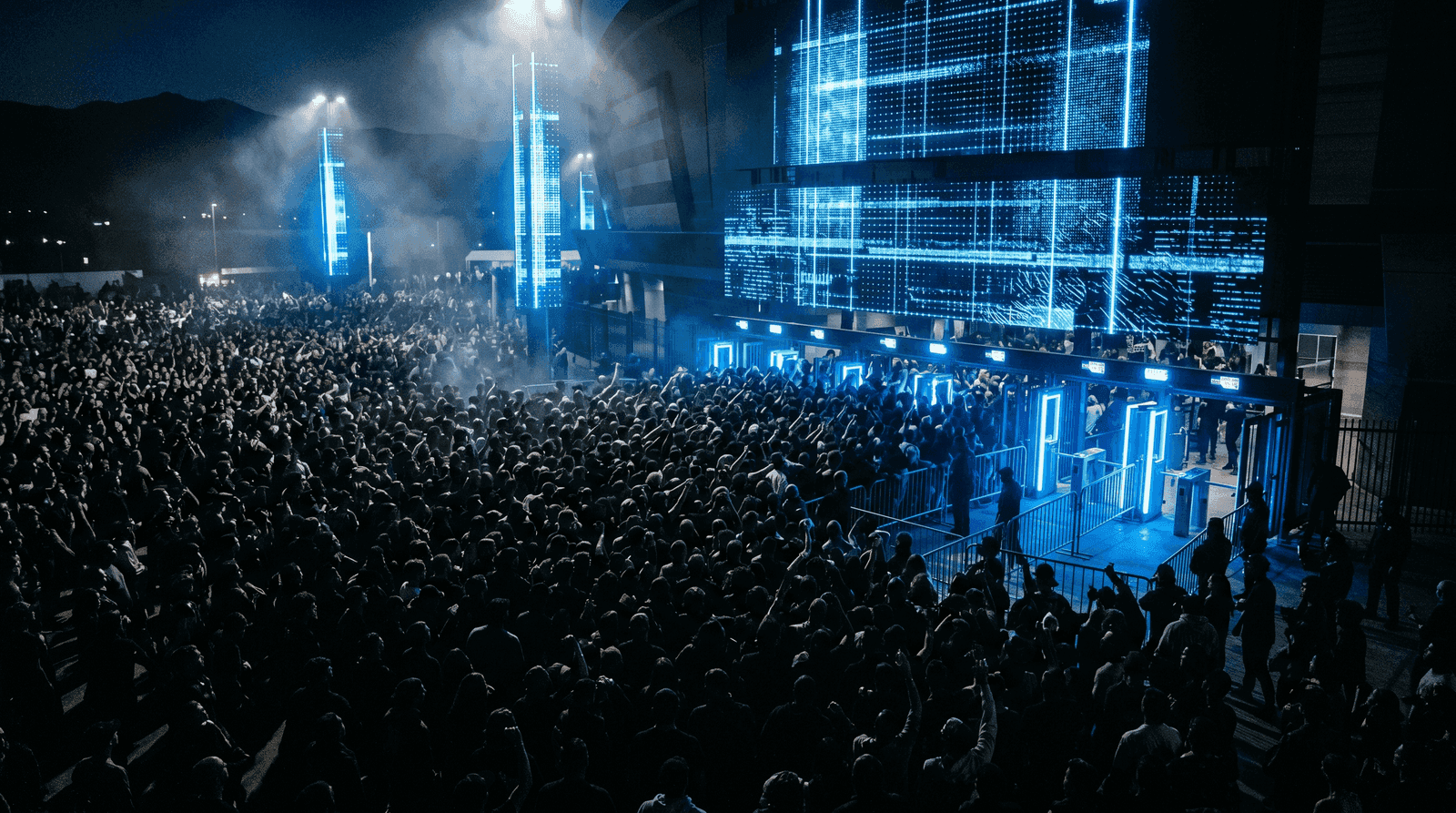
It meets the only test that matters. When a hot show goes live, tens of thousands of buyers can hit the purchase page in the same few seconds, spiking traffic by orders of magnitude beyond anything the system sees on a normal day. A platform that was not architected for that exact moment slows to a crawl or falls over, and every failed checkout is a furious customer and a screenshot on social media.
Surviving an onsale is its own engineering discipline. You need a virtual waiting room that holds buyers in an orderly queue and releases them at a controlled rate, the kind of thing dedicated vendors like Queue-it and Queue-Fair exist to provide. You need auto-scaling and load balancing so you can add capacity in seconds. You need asynchronous queuing for database writes so your transactional backend does not lock up under peak concurrency. And you need to load test all of it, well above your expected peak, weeks before the real thing.
A festival that builds its own platform inherits every bit of that. A festival that white-labels inherits a platform where someone else already solved it, across hundreds of other onsales, and gets paged at 3am instead of you.
The onsale is only one test. Creating smoother entry and scanning at the door requires the same level of load planning — and is equally hard to retrofit into a homegrown system after the fact.
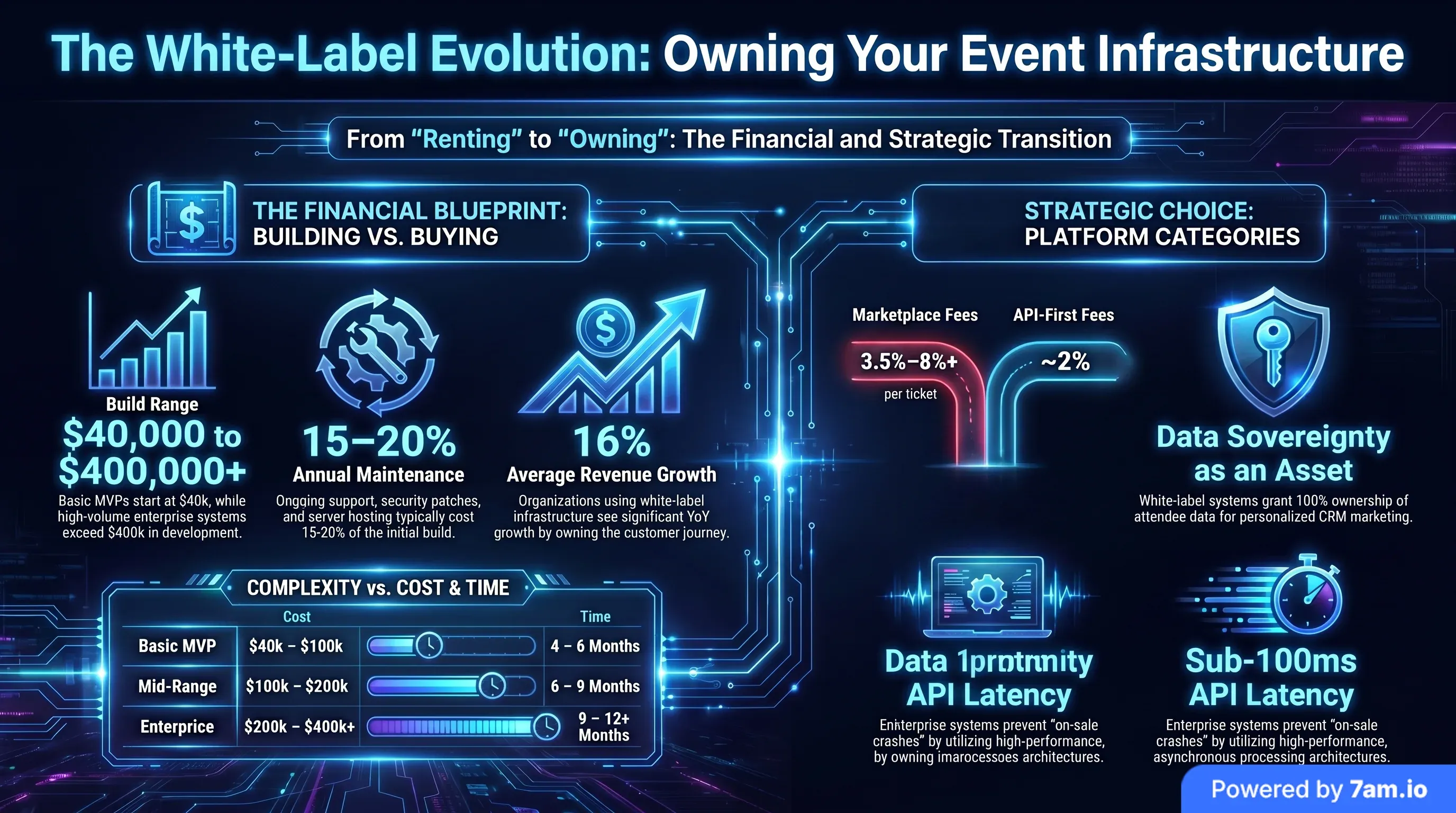
White-label gives you the branded buyer experience and the customer relationship without the engineering liability underneath. Buyers see your name, your colours, your domain. You see the orders, the data, and the payout. The platform vendor sees none of your audience and competes with you for none of it.
That last point is the one that separates a real white-label partner from a marketplace wearing a costume. On Eventbrite or Ticketmaster, the platform owns the buyer and rents them back to you. A proper white-label platform inverts that. The branding is yours, the customer data is yours to export and remarket to, and the platform stays invisible. If a provider charges you to access your own customer info, they are a landlord, not a partner. That is the difference between renting an audience and owning one.
Your attendee data is worth more than your lineup — and understanding that value is exactly the argument for keeping it under your brand, not a marketplace's.
Losing your brand when selling tickets online is a real operational risk. Once buyers associate a competitor's checkout experience with your event, that perception is hard to undo.
You also offload the parts of the build that never end. Security patching, PCI renewals, payment-provider changes, the next Stripe API version, the next onsale traffic record. All of it becomes the vendor's job. You get to spend your time on events and customers, which is presumably why you got into this in the first place.
Building makes sense in one situation: when ticketing technology is the product you sell, and owning the IP is the point.
If you are launching a venue-management SaaS and ticketing is a feature your customers will pay for, owning it is defensible, because the software is the asset you are building equity in. If you are a national operator at enormous volume where a few points of revenue share is millions of dollars a year, an in-house build can pencil out. And if you have genuinely novel requirements that no platform on the market can meet, you may have no choice.
A rough rule of thumb on volume: organisations with gross ticket revenue exceeding $2 million per year typically find the build cost offset within 12 to 18 months, once they eliminate the 2 to 5% marketplace fee on every sale. Below that threshold, the maths rarely works in building's favour.
At that scale, understanding how ticketing platforms drive growth and profitability — and whether you are extracting that value through the platform or losing it to one — is the real financial question.
Outside those cases, building is usually ego or under-estimation wearing a business case. The honest test: if you would not be comfortable employing two senior backend engineers permanently to keep the thing alive and compliant, you should not build it. White-label exists precisely so you do not have to.
Days to weeks, against the 5 to 12 months a build takes. The branded buyer experience is configuration, not construction. You set up your event pages with your artwork and branding, connect a payment account, define your ticket types, and you are selling.
The maths flips hard in white-label's favour here. Every week a self-built platform is in development is a week of zero ticket revenue and full burn. A white-label launch starts earning while the build team would still be in discovery. Speed is not a nice-to-have here. For a new ticketing brand, time-to-first-onsale is the whole game, because the first events you win are the proof you need to win the next ten.
Before committing to any platform, running a step-by-step evaluation of ticketing system options will surface the configuration and onboarding requirements you need to account for in your launch timeline.
7am is built for exactly this path. You get custom-branded event pages on your own brand, flexible ticket types, seating plans and reserved seating, ticket resale, door scanning through the 7am Business App, and real-time sales reporting, with payments running through Stripe and Afterpay. The booking fee can start from as low as 5% per ticket or a fixed amount, and you choose whether to absorb it or pass it to the buyer. No setup fee, no monthly fee, no custom-software bill to launch.
Five things separate a platform you can build a business on from one you will outgrow or resent. Score any vendor against these before you sign.
| What to check | Why it matters | The question to ask |
|---|---|---|
| Brand and domain control | If their name shows up at checkout, it is not white-label | "Do buyers ever see your brand?" |
| Customer data ownership | You cannot remarket to an audience you do not hold | "Can I export every attendee's contact?" |
| Fee flexibility | A rigid fee model caps your margin | "Can I set the booking fee and choose who pays it?" |
| Feature depth | Seating, resale, and scanning are expensive to add later | "Do you handle reserved seating and door entry today?" |
| No audience competition | A platform that resells your buyers is a rival | "Do you market other events to my customers?" |
The full picture of how ticketing fees eat into organisers' profits — including all the charges beyond the headline percentage — is worth reading before you evaluate any platform.
The reason businesses leave Ticketmaster is that its service fees commonly run 27 to 31% of the ticket price, and the organiser controls none of it. Dynamic pricing on marketplace platforms compounds the problem: the platform adjusts fees in response to demand, and you find out when the fans complain. A white-label model where you set the fee structure puts that control back in your hands.
A white-label platform where you set the booking fee, from something like 5% up, and decide whether the buyer or you absorbs it, hands that control back. That swing, from a quarter of every ticket gone to a fee you set yourself, is the entire financial argument for running your own platform.
Build a ticketing platform from scratch only if ticketing technology is the product you sell and you are ready to fund it like a permanent engineering team, because that is what it is. For nearly everyone else, white-labelling delivers the same branded experience and the same owned customer relationship in weeks instead of months, without the payments compliance, the onsale firefights, or the six-figure build.
The features that take longest to build right, seating plans, door sales, and real-time scanning, are the ones a mature white-label platform has already solved.
The smart move is rarely to own the road. It is to own the brand on it, the data behind it, and the margin from it, and let a platform like 7am carry the rest.
Explore More
View All