Lorem ipsum dolor sit amet, consetetur sadipscing elitr, sed diam nonumy eirmod.
Lorem ipsum dolor sit amet, consetetur sadipscing elitr, sed diam nonumy eirmod.

Alex
May 3, 2026
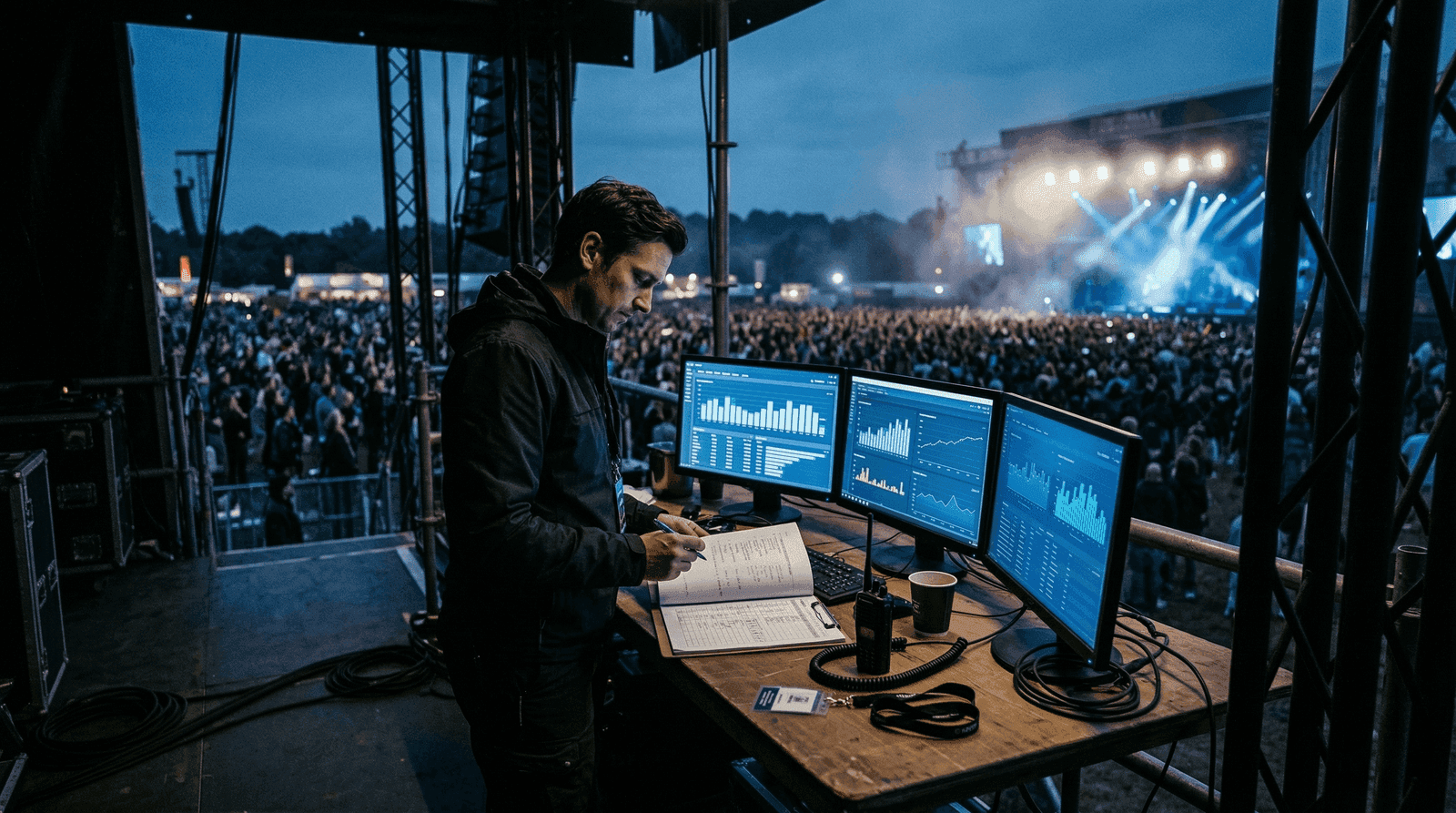
Most event organisers treat profitability as a consequence of ticket sales. Sell enough tickets, and the event makes money. This assumption kills more first-time events than bad weather. The 2026 festival cancellation wave proves it or weak lineups combined.
Profitable events are engineered, not hoped for. The first place most organisers go wrong is treating ticketing as a utility instead of a strategic decision. They're built on three structural levers: ticket revenue design (and organisers who sell 70% before announcing a lineup prove this works), secondary spend maximisation, and cost discipline. Understanding when your audience actually buys changes how you plan cash flow for all three. Organisers who master all three consistently produce 15-20% net margins. Those who focus only on ticket price struggle to break even.
This guide breaks down the framework professional organisers use to structure events that actually make money, including a real $100k budget breakdown, tiered pricing strategy, and the metrics you should track from day one.
Every profitable event operates on three levers. Most organisers optimise only the first one and ignore the other two, which is where the real margin lives.
Lever 1: Ticket Revenue Design. This includes tiered pricing, early bird strategy, VIP packages, group discounts, and dynamic pricing. The goal isn't maximum ticket price. It's maximum revenue per available capacity unit across the full sales cycle.
Lever 2: Secondary Spend. Bar revenue, merchandise, food and beverage, VIP upgrades, parking, and add-ons. Industry data shows organisers generate approximately $26.62 in additional revenue per attendee beyond the base ticket price. On-site spending typically contributes 15-30% of total live event revenue. For festivals, this number can exceed 40%.
Lever 3: Cost Discipline. Break-even modelling, contingency reserves, vendor negotiation, payment timing, and production scaling. Festivals operate on 10-20% margins. A single budget overrun can eliminate profit entirely. Professional organisers build cost control into the event structure from day one.
The framework works because it shifts the conversation from "what should I charge for tickets?" to "how do I design an event that generates revenue at every touchpoint while controlling costs?"
Tiered pricing uses multiple price levels that increase over time or as inventory depletes. It's the highest-impact lever in ticket revenue design (and organisers who sell 70% before announcing a lineup prove this works) because it captures different willingness-to-pay across your buyer base.
Most events perform best with 3-4 tiers:
| Tier | Price Point | Capacity Allocation | Purpose |
|---|---|---|---|
| Early Bird | 25-30% below regular | First 30% of capacity | Cash flow generation, demand validation |
| Regular | Standard price | 40% of capacity | Core revenue, highest volume |
| Late Bird | 15-20% above regular | 20% of capacity | Captures committed buyers willing to pay more |
| Last Chance | 25-30% above regular | Final 10% of capacity | Maximises revenue from high-intent late buyers |
Naming matters. Name tiers intuitively so buyers immediately understand which ticket is cheapest and what urgency exists. Confusing tier names reduce conversion. Call them Early Bird, Advance, Regular, Last Chance. Done.
Scarcity accelerates purchases. Displaying remaining ticket count increases purchase velocity by 35% when inventory drops below 15% of capacity within a tier. "Only 47 Early Bird tickets remaining" converts browsers into buyers.
Don't forget the vertical axis. Beyond time-based tiers, add experience tiers: General Admission, Premium (better viewing, shorter queues), and VIP (meet-and-greet, exclusive areas, premium F&B). Well-designed VIP tiers boost revenue per fan by 20% or more without raising base ticket prices.
Early bird pricing is a financial strategy that determines whether your event has cash to spend on production, marketing, and talent. Full stop.
Early bird tickets go on sale 60-90 days before the event. For festivals, super-early-bird sales can start 6-12 months out. The timing aligns with your production cash flow needs: you want early bird revenue arriving before your biggest outflows.
What early bird sales do for your event:
Generate cash flow when you need it most. Artist deposits (typically 50% on signing), venue deposits, and production equipment orders all require cash months before doors open. Early bird revenue funds these commitments.
Validate demand before you commit. If early bird sales are tracking below 50% of allocation at the halfway point, you have a clear signal to adjust. Reduce production scale, increase marketing spend, or revise pricing.
Create organic marketing. Every early bird buyer becomes a promoter. They've committed financially and now have incentive to invite friends, share on social media, and build anticipation. Referral programs during the early bird phase can deliver a 30x ROI compared to paid advertising.
Set the pricing anchor. The early bird price establishes perceived value. When regular pricing kicks in 20-30% higher, it creates urgency for the next wave of buyers and makes the standard price feel justified.
The Go/No-Go checkpoint. Professional organisers set specific dates at 90, 60, and 30 days out to evaluate ticket sales against targets. If early bird sales haven't hit 50% of their allocation by the midpoint of the early bird window, it's time to make hard decisions. Scale back production. Pivot marketing. Or in extreme cases, cancel before costs escalate beyond recovery.
Ticket revenue gets all the attention. Secondary spend is where margins live.
Industry benchmarks show that on-site spending contributes 15-30% of total live event revenue. The average additional revenue per attendee beyond tickets is $26.62. For well-designed festivals, secondary revenue can exceed 40% of total take.
Bar and beverage revenue carries margins of 60-70% and is the single highest-margin revenue stream at most live events. Token or cashless payment systems reduce transaction friction and increase average spend per attendee by 15-20%.
Merchandise works at multiple touchpoints. Pre-event online sales, on-site booths, post-event follow-up stores. Pairing physical merchandise with digital bonuses (exclusive content, backstage footage) increases cart size and perceived value.
VIP and premium experiences boost revenue per fan by 20%+ without increasing base capacity costs. Backstage access, artist meet-and-greets, premium viewing areas, expedited entry. The key is clearly communicating what VIP includes: use visuals, testimonials, and GA-vs-VIP comparison tables.
Unified commerce platforms let organisers sell tickets, merch, parking, and experiences in a single transaction flow. This approach can increase average order value by up to 220% compared to ticket-only checkout. Platforms like 7am support this unified approach.
Food and beverage partnerships can be structured as revenue-share agreements (typically 15-25% of F&B sales) rather than flat rental fees, aligning vendor incentives with event attendance.
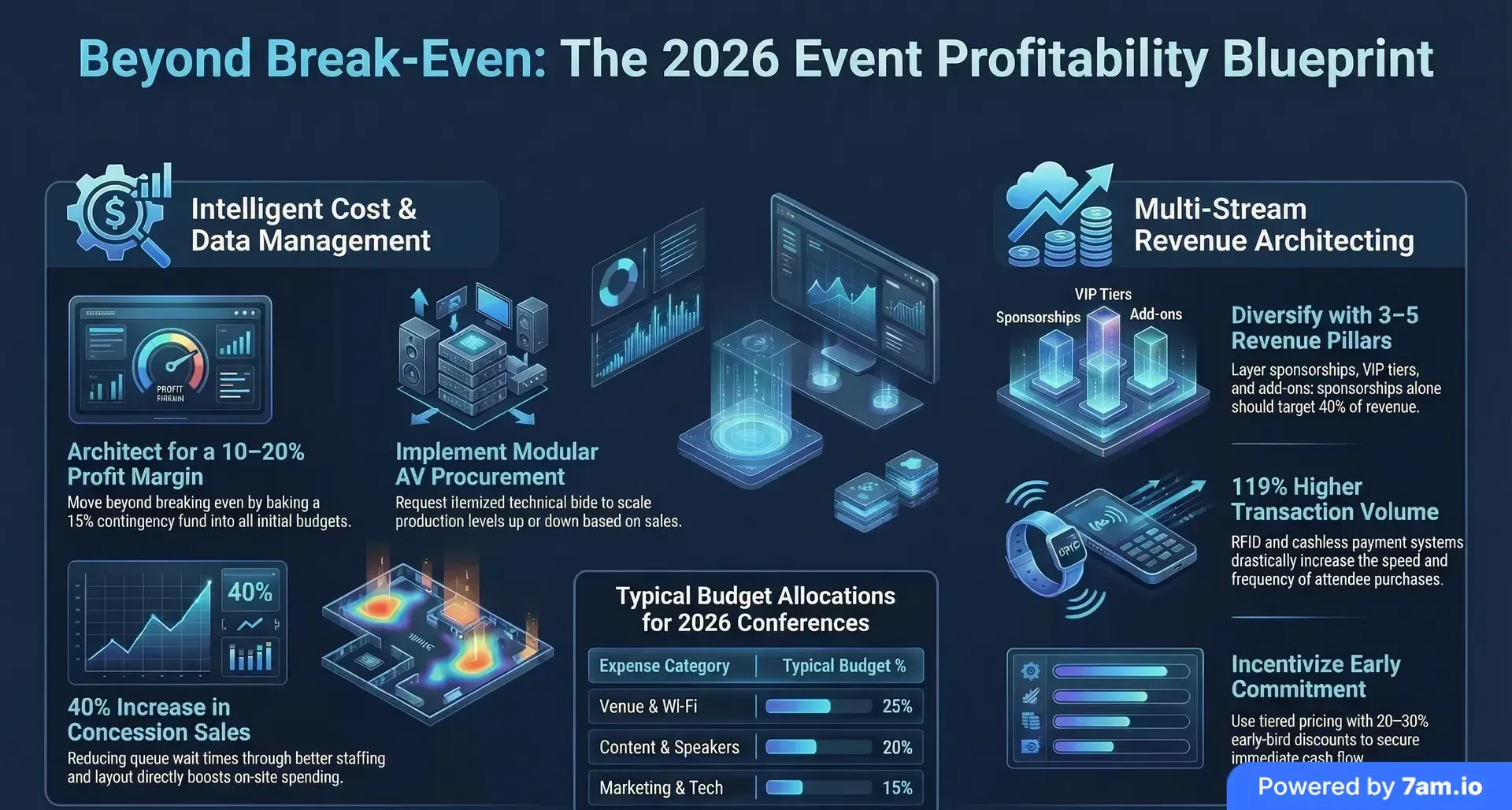
Understanding where money goes is the foundation of cost discipline. Understanding when your audience actually buys changes how you plan cash flow for all three. Here's a realistic breakdown for a $100,000 event budget:
| Category | % of Budget | Amount | Notes |
|---|---|---|---|
| Talent / Entertainment | 30-40% | $30,000-40,000 | Headliners, support acts, DJs, MCs. Stagger payments: 25-30% deposit, 30% at 30 days, remainder post-event. |
| Venue & Production | 20-25% | $20,000-25,000 | Venue hire, staging, lighting, sound, power. Get quotes from 3+ suppliers. |
| Marketing & Promotion | 10-15% | $10,000-15,000 | Paid ads, content creation, PR, social media. Front-load spend to drive early bird sales. |
| Staffing & Security | 10-12% | $10,000-12,000 | Security, bar staff, volunteers, event managers. Scale with confirmed attendance. |
| Food & Beverage | 8-10% | $8,000-10,000 | Catering, bar setup, vendor infrastructure. Consider revenue-share vs flat fee. |
| Insurance & Permits | 3-5% | $3,000-5,000 | Public liability, cancellation insurance, council permits. Non-negotiable. |
| Technology & Ticketing | 2-3% | $2,000-3,000 | Ticketing platform, scanning, Wi-Fi, cashless systems. |
| Contingency Reserve | 10-15% | $10,000-15,000 | Weather, equipment failure, last-minute costs. Never touch this unless critical. |
Revenue targets for this budget:
The critical rule: If your break-even point requires selling more than 70% of venue capacity, either your costs are too high or your venue is too small. Restructure before launching sales.
A break-even model answers one question: how many tickets do you need to sell before you start making money?
Step 1: Calculate fixed costs. These don't change regardless of attendance. Venue hire, permits, insurance, base production, headliner fees. For a $100k event, fixed costs typically represent 60-70% of budget ($60,000-$70,000).
Step 2: Calculate variable costs per attendee. These scale with attendance. Per-head catering, additional security, cleaning, disposables. Typically $5-15 per attendee.
Step 3: Determine average revenue per attendee. Include ticket price plus estimated secondary spend. If average ticket price is $85 and secondary spend is $26, average revenue per attendee is $111.
Step 4: Calculate break-even attendance. Break-even = Fixed Costs ÷ (Revenue per Attendee - Variable Cost per Attendee) = $65,000 ÷ ($111 - $10) = 644 attendees
Step 5: Build in your margin target. For 15% net profit on $100k total costs: Target attendance = ($100,000 + $15,000 profit) ÷ ($111 - $10) = 1,139 attendees
Step 6: Validate against venue capacity. If your venue holds 1,500, a target of 1,139 (76% capacity) is aggressive but achievable. If your venue holds 1,200, you're targeting 95% capacity. That's unrealistic. Reduce costs or find a larger venue.
The break-even model becomes your Go/No-Go framework. Set checkpoints at 90, 60, and 30 days before the event. If ticket sales aren't tracking toward break-even attendance, trigger your contingency plan. Scale production down, increase marketing, or make the difficult decision to cancel early.
Track these metrics to understand whether your event is on track for profitability:
Pre-event metrics:
Event-day metrics:
Post-event metrics:
Single-event profitability is hard. Multi-event profitability is where organisers build sustainable businesses.
Data compounds. Every event generates customer data: emails, purchase history, ticket tier preferences, geographic data. Organisers who own this data remarket to past attendees for near-zero acquisition cost. Those on marketplace platforms start from scratch every time.
Brand compounds. Events that sell tickets on their own domain build SEO authority, brand recognition, and direct customer relationships. Over 5 events, an organiser with 2,000 attendees each builds a 10,000-person remarketing audience. Those on marketplaces build nothing.
Negotiating power compounds. Organisers with a track record of consistent attendance and profitability negotiate better vendor terms, attract stronger talent at lower rates, and secure venue deals that new organisers can't access.
The flywheel: Profitable first event → reinvest in data and brand → lower acquisition costs for event two → higher margin → stronger negotiating position → scale up production → more profitable events.
This is why the ticketing infrastructure decision matters so much. Organisers on 7am own their customer data, receive instant payouts to fund production, and build their brand on their own domain. All of which compound into multi-event profitability.
And be careful with pricing strategy. Dynamic pricing can backfire badly if your audience values transparency.
Profitable events aren't built on hope. They're built on structure. The Event Profitability Framework operates on three levers: ticket revenue design (and organisers who sell 70% before announcing a lineup prove this works) (tiered pricing, early bird, VIP), secondary spend maximisation (bar, merch, experiences), and cost discipline. Understanding when your audience actually buys changes how you plan cash flow for all three (break-even modelling, contingency reserves, vendor negotiation).
Build your break-even model before you launch sales. Set Go/No-Go checkpoints at 90, 60, and 30 days. Track revenue per attendee, not just ticket sales. Invest in ticketing infrastructure that gives you data ownership, instant payouts, and brand control. Profitability compounds across events, and you can only compound what you own.
Build your next profitable event with 7am. Instant payouts, full data ownership, and unified commerce from day one.
Explore More
View All