Lorem ipsum dolor sit amet, consetetur sadipscing elitr, sed diam nonumy eirmod.
Lorem ipsum dolor sit amet, consetetur sadipscing elitr, sed diam nonumy eirmod.

Alex
May 3, 2026
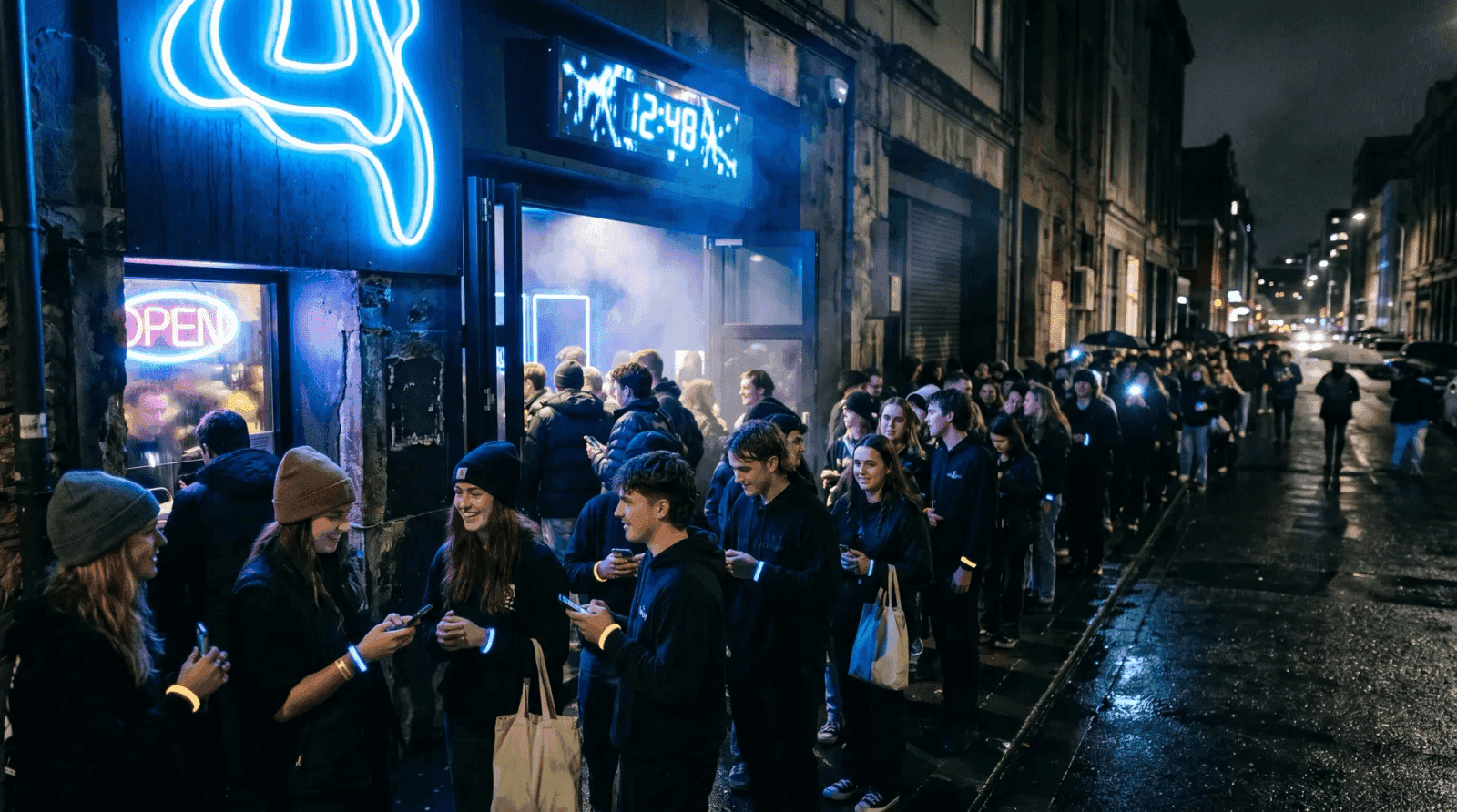
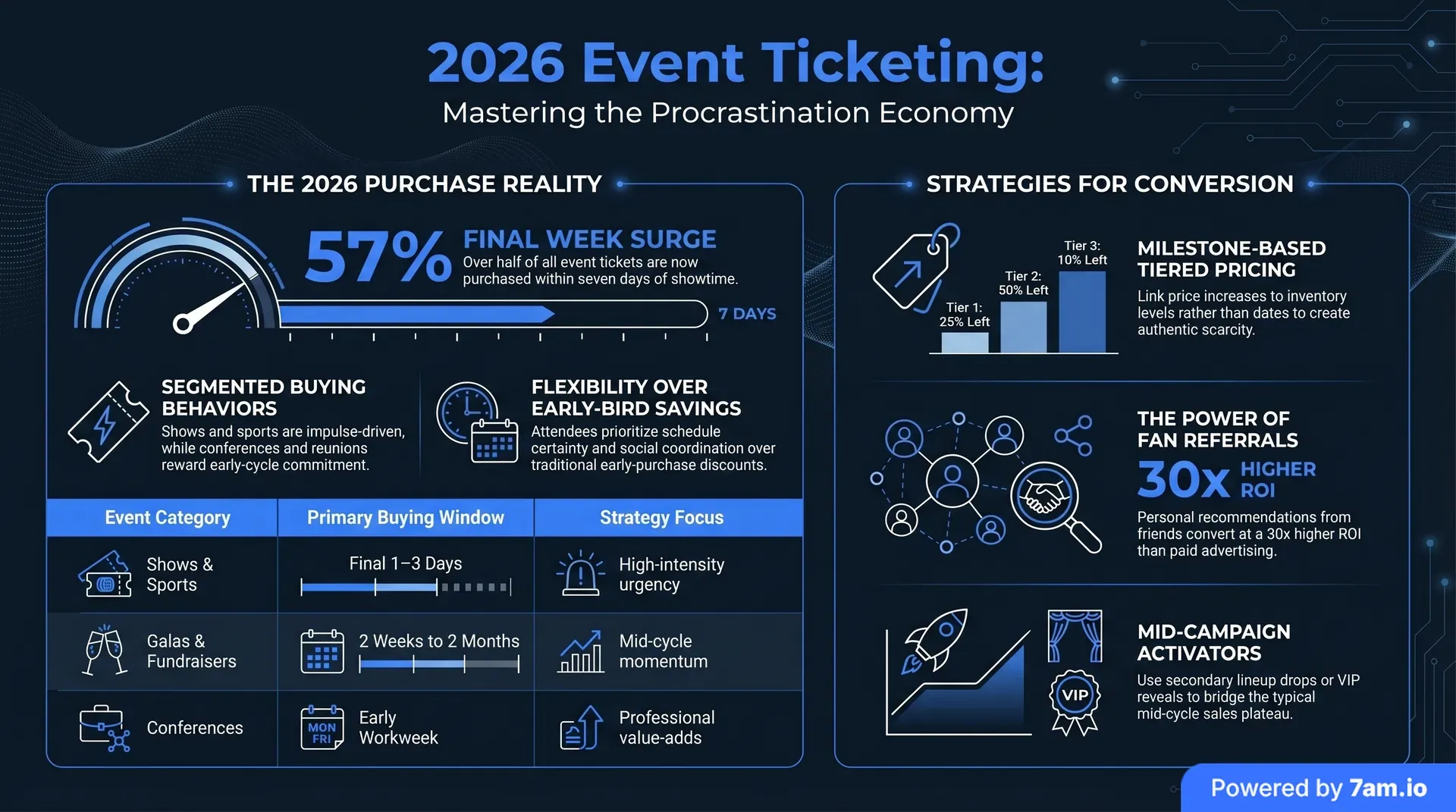
Yes. Pollstar data from 2022 to 2024 shows 57% of tickets for live events now sell within the final week before the event date. The average on-sale window has shrunk by 26% over that same period.
This is not a blip. It is a structural shift in how people buy tickets. The pandemic broke the old pattern where a strong on-sale day predicted overall success. Audiences learned to wait. They watched friends post stories from events, saw availability hold, and realised there was no penalty for deciding on Wednesday what to do on Saturday.
For organisers who built their entire campaign model around early-bird surges and long lead times, this feels like a crisis. It is not. The money still arrives. It just arrives later, faster, and in a compressed window that rewards preparation over panic.
The organisers getting crushed by this shift are the ones checking their dashboard three weeks out, seeing 30% sold, and slashing prices or pulling marketing spend. The ones thriving have restructured their entire operation around a simple truth: the sales curve has moved, and their planning needs to move with it.
No. The timing of ticket purchases varies dramatically by event category. Shows and performances see 32.7% of sales in the final week. Conferences see only 15.1%. Understanding your category's curve is the difference between confident planning and unnecessary panic.
Festivals sit at the extreme end. Between 40% and 50% of festival tickets sell in the final month before gates open. The buying trigger is social coordination. Friend groups commit together, and the conversation that converts a group of six from "maybe" to "we're going" typically happens 10 to 14 days before the event. One person buys, screenshots the confirmation, drops it in the group chat, and five more follow within hours.
Shows and performances peak on Fridays, with 18.8% of all weekly purchases landing that day. People finalise weekend plans at the end of the work week. The casual concertgoer scrolling Instagram on a Friday lunch break, seeing a promoted post for a Saturday night show, and buying two tickets before finishing their coffee. That is the dominant purchase path now.
Sports and recreation follow a similar Friday peak at 18.1%, but the advance window is shorter. Rugby, cricket, and league matches in New Zealand and Australia often see a surge after Thursday team announcements. Fans wait to confirm the squad before committing.
Conferences are the outlier. Registrations peak on Tuesdays and Wednesdays because attendees treat conference sign-up as a work task, not a social one. They process it during office hours, often requiring manager approval or a purchase order. The 2-month-plus advance window reflects corporate procurement timelines, not consumer behaviour. If you run a B2B conference and only 15% of registrations come in the final week, that is normal and healthy.
Galas and fundraisers land in the middle. A full 55.5% of gala tickets sell in the two-week to two-month window. The audience is socially obligated. They know they will attend. They buy once the decision is made, which happens well in advance, but they rarely buy impulsively. Gala organisers can rely on a steadier, more predictable curve than any other category.
Three forces have converged: unlimited entertainment options creating decision fatigue, mobile purchasing removing friction from last-minute buying, and social coordination shifting the commitment trigger from marketing to peer pressure.
The first force is simple oversupply. In any given week in Auckland or Melbourne, there are dozens of events competing for the same discretionary dollar. People have learned not to commit early because something better might come along. Holding off is rational when your feed shows new options every day.
Mobile commerce removed the old barriers. Buying a ticket in 2015 meant sitting at a computer, navigating a clunky checkout, entering card details, and printing a PDF. Today it takes 45 seconds on a phone. That collapse in purchase friction means there is no practical cost to waiting. You can buy on the bus to the venue.
But the biggest driver is social coordination. Research into festival and concert purchasing consistently points to the same finding: people do not buy tickets alone. They buy with friends. And friends take time to align. The group chat negotiation, "Are we going?", "Who else is in?", "Can anyone do Saturday?", that process now happens in the final 10 days. Once the group commits, the purchases follow in a burst.
This social dynamic also explains why certain ticketing mistakes cost event organisers real money. If your checkout process cannot handle a group of friends all buying simultaneously on their phones, you lose sales at the exact moment demand peaks.
Yes, but calibrate your expectations to the event type. Early-bird pricing is highly effective for conferences and galas. For shows and festivals, it functions more as a cash flow tool and community signal than a volume driver.
Conference early-bird pricing works because the buyer and the decision-maker are often different people. The attendee wants the discount to justify the expense to their manager. "I saved $200 by registering early" is a procurement argument. This is why conference early-bird tiers can move 40% or more of total registrations months in advance.
For festivals and concerts, early-bird tiers serve a different purpose. They identify your most committed fans, generate seed revenue for deposits and production, and create the first wave of social proof. But the volume is smaller. Expect 10 to 20% of total sales from early tiers for leisure events. If you are budgeting for 50% of a concert's tickets to sell in the first month, you are going to have a stressful lead-up.
The smarter approach is to layer your pricing architecture around how your specific audience actually buys. This framework for structuring profitable events breaks down the financial model. The short version: plan your break-even point around 60% capacity, assume 50% of revenue arrives in the final month, and treat everything before that as a bonus that de-risks the operation.
Shift your campaign weight towards the final 14 days. Budget 50 to 60% of your paid media spend for the last two weeks, and use the preceding months to build awareness and warm audiences you will retarget later.
The old model was to spend big at launch, ride the early-bird wave, then taper off. That model assumed people bought early. They do not anymore. The new model has three phases.
Phase one: Awareness seeding (8 to 4 weeks out). This phase is about reach, not conversion. Run brand awareness and video view campaigns on Meta and TikTok. Get your event into people's feeds. Build custom audiences of video viewers, page visitors, and engagers. You are loading the retargeting pool.
Do not spend heavily here. This is 15 to 20% of your total media budget. The goal is not sales. It is recognition.
Phase two: Social proof and content (4 to 2 weeks out). Start showing the evidence. Past event footage, artist announcements, venue walk-throughs, testimonial clips. Share ticket milestone updates: "500 tickets sold, 300 remaining." Post UGC from past events. This is where people move from "I know about this" to "I want to go to this."
Budget allocation: 20 to 30% of total spend. Mix organic content with boosted posts and retargeting ads aimed at your Phase 1 warm audiences.
Phase three: Conversion push (final 14 days). This is where you spend. Retarget every warm audience segment with direct response ads. Urgency-driven copy: "Limited tickets. This Saturday." Countdown creative. Final price messaging. Flash sale if needed.
Flash sales are particularly powerful in this window. A 24 to 48 hour discount, even just 10 to 15%, can reignite a stalled campaign within 48 hours. The urgency of a ticking clock combined with a genuine price drop converts the fence-sitters who have been watching your event for weeks.
Budget allocation: 50 to 60% of total spend.
Plan for 50% of your ticket revenue to land in the final month. Structure supplier payments, artist deposits, and production costs around that reality, not around an optimistic early-sales forecast.
This is where late-buying patterns become a genuine operational challenge. You cannot ignore it and you should not pretend early-bird revenue will cover your pre-event costs. Here is a practical cash flow framework.
Map your fixed costs by payment deadline. Venue hire is often due 3 to 6 months out. Artist deposits 2 to 3 months. Production and staging 4 to 6 weeks. Marketing spend is continuous. Knowing exactly when each payment falls due tells you how much pre-event revenue you actually need.
For a $100,000 gross revenue target, assume $15,000 to $20,000 from early-bird tiers (months out), $30,000 to $35,000 in the 2 to 4 week window, and $45,000 to $50,000 in the final week. If your venue deposit of $25,000 is due 4 months before the event, early-bird revenue alone will not cover it. You need either a deposit structure with your venue, a line of credit, or savings from previous events.
7am gives organisers real-time sales dashboards so you can track daily revenue against your cash flow milestones. Knowing exactly where you stand at any point removes the guesswork that makes late-buying patterns feel so stressful.
The organisers who handle this well maintain a cash reserve equal to 30 to 40% of their total fixed costs. That buffer covers the gap between early expenses and late revenue. It turns the last-minute sales curve from a source of anxiety into a predictable pattern you plan around.
Stop comparing daily sales to historical curves that assumed early buying. Instead, track two leading indicators: warm audience size (email list, retargeting pools, social followers) and conversion rate in the final 14-day window.
Traditional forecasting said: "We sold 400 tickets in the first week last year and ended at 2,000, so 400 in week one this year means we are on track." That logic breaks down when the entire curve has shifted later. You could sell 200 in week one and still hit 2,000, if your warm audience is large enough and your conversion push is strong.
The better model tracks your total addressable warm audience. How many people have engaged with your event content? How many are on your email list? How many have visited the ticket page without purchasing? Those numbers, not early sales, predict your final outcome.
If your retargeting pool is 15,000 people two weeks out and your historical conversion rate on retargeting ads is 3%, you can project roughly 450 ticket sales from that channel alone. Add email conversions, organic social, and word-of-mouth, and you have a realistic forecast that does not depend on early sales volume.
This is also why owning your attendee data matters so much. Third-party platforms that sit between you and your audience make it impossible to build and measure warm audience pools. When you own the data, you can forecast with confidence.
Yes. Events that combine identity-driven branding with tiered scarcity still shift 40 to 55% of tickets before the final month. The late-buying trend is a default, not a destiny.
The 57% last-week figure is an average across all events, including those with weak marketing, no email strategy, and generic positioning. The best-run events in New Zealand and Australia consistently outperform that average by selling earlier.
How? They give people a reason to commit before the group chat conversation starts. Tiered pricing with visible sell-through counts ("87 of 200 early bird remaining") creates individual urgency. Limited VIP or experience-add-on packages give superfans a reason to lock in early. Community presales for mailing list subscribers make the early buyer feel rewarded.
The playbook for selling 70% of tickets before your lineup drops goes deep on this. The core insight: you are not fighting the late-buying trend. You are creating a parallel buying channel for people who want to commit early and rewarding them for doing so. The late buyers still come. But now you have revenue from both ends of the curve.
Build your campaign around cinematic, story-led short-form video. In 2026, the events winning the attention battle are the ones producing 15 to 60 second clips that let audiences feel the event before committing.
Static flyers with a lineup list and a date no longer convert. The scroll is too fast. What stops thumbs is footage that creates an emotional reaction in under 3 seconds. A crowd singing in unison at dusk. A drone shot pulling back from a packed outdoor stage. A close-up of someone's face the moment the bass drops. These are not expensive to produce if you film intentionally at your event.
Invest in capturing 50 to 100 short clips during your next event. Crowd reactions, backstage moments, venue details, food stalls, sunsets, friends meeting at the gate. That library of raw footage becomes your marketing engine for the next 12 months. Every week, cut a new 15-second clip. Every tier launch, drop a 60-second highlight reel.
Pair this with a shift in your paid media strategy. Meta and TikTok algorithms in 2026 heavily favour video content. A $500 boost on a strong 15-second Reel will outperform a $2,000 spend on a static image ad. The cost-per-view on video is a fraction of the cost-per-click on static, and the retargeting audiences you build from video viewers convert at higher rates.
The other 2026 shift: invest in your first-party data infrastructure. Build your email list. Use a ticketing platform like 7am that gives you direct access to buyer data. Create SMS lists for your most engaged audience. As ad costs rise and algorithm reach declines, your owned channels become the most reliable path to ticket sales.
This shift is one reason festivals are struggling financially in 2026. Late revenue and upfront costs don't mix.
And whatever you do, don't respond to slow early sales by switching to dynamic pricing. That trades one problem for a worse one.
The 57% figure is not a problem to solve. It is a pattern to plan around. Match your budget phasing, cash flow structure, and content calendar to the way people actually buy, and the compressed sales curve becomes a feature of your operation, not a flaw.
Explore More
View All