
Lorem ipsum dolor sit amet, consetetur sadipscing elitr, sed diam nonumy eirmod.
Lorem ipsum dolor sit amet, consetetur sadipscing elitr, sed diam nonumy eirmod.

Valentin
May 3, 2026

Most event organisers treat ticketing like a utility. The same passive approach leads organisers into dynamic pricing traps that erode fan trust. Pick a platform, set a price, sell tickets. Done.
Except the actual decision affects cash flow, customer data ownership, marketing control. Festivals that lost this control are the ones shutting down in 2026, and long-term brand equity. With 57% of tickets now selling in the final week, having control over your sales data and remarketing is more critical than ever. The gap between marketplace ticketing and infrastructure-first ticketing goes beyond fees. It comes down to who controls the relationship with your audience. We covered this in detail in why attendee data ownership matters. Marketplace platforms like Eventbrite, Ticketmaster, and iTICKET trade convenience for control, and the compound cost of that trade-off can reach hundreds of thousands of dollars over a multi-event career.
This guide breaks down the specific mistakes that cost organisers the most, and the questions you should ask before choosing (or staying with) a ticketing platform.
Marketplace ticketing means selling your event on someone else's platform, alongside thousands of competing events. Infrastructure ticketing means owning the system: your brand, your domain, your data.
Marketplace platforms (Eventbrite, Ticketmaster, Humanitix, iTICKET) aggregate events into a public discovery marketplace. Your event page lives on their domain. Attendees buy from the marketplace, not from you. The platform sets the checkout flow, controls the customer data, and decides what competing events appear alongside yours.
Infrastructure-first platforms (7am, Ticket Tailor, Eventcube, Tixr) give you a branded ticket shop on your own domain. You control the design, the checkout experience, and every piece of customer data. No marketplace promoting competitor events on your page.
That convenience marketplace platforms sell you? It compounds against you with every event you run.
On most marketplace platforms, the platform owns or co-owns the customer data. Not you.
This is the single most expensive mistake organisers make without realising it.
When you sell through Eventbrite, the platform uses attendee data to recommend competing events to your audience. Ticketmaster's ecosystem routes customers back into their marketplace after purchase. You built the event. They keep the audience.
Modern platforms like Tixr explicitly state that "event organizers fully own and control all customer data," with "complete access to purchaser and attendee information for segmentation, retargeting, and analysis." Ticket Fairy gives organisers "complete ownership and control of your customer data." 7am follows the same principle.
What you lose without data ownership:
Think about what that means in practice. An organiser running 5 events per year with 2,000 attendees each loses access to 10,000 customer records annually. Over five years, that's 50,000 contacts you could be remarketing to for free instead of paying to acquire them again through paid ads. Every single one of those people already wanted to come to your event. You just can't reach them.
Most marketplace platforms hold your ticket revenue for 5-10 days after the event ends. Sometimes longer. For festivals spending six figures on production months before doors open, this creates a cash flow gap that can kill an otherwise profitable event.
The typical payout timeline on marketplace platforms:
Compare that with infrastructure platforms:
Here's where it gets real. A festival with $200,000 in production costs and $300,000 in ticket revenue, waiting 2-4 weeks for payouts, faces three bad options: take on short-term debt to cover production costs, reduce production quality to match available cash, or pay interest on bridging loans that eat into margins.
Festivals operate on 10-20% margins. A $15,000 bridging loan to cover a payout delay can wipe out the profit on a smaller event entirely.
When attendees buy tickets through a marketplace, they remember the marketplace. Not your brand. Every touchpoint reinforces someone else's identity.
The brand dilution chain:
White-label ticketing reverses this entirely. Every step, from the ticket page on your domain to the branded confirmation email, reinforces your identity. Attendees buy from you, receive communications from you, and associate the experience with your brand.
For event brands building a multi-year following, this distinction compounds dramatically. A festival that sells 10,000 tickets per year builds 10,000 brand impressions per year on a marketplace. On their own domain, those same 10,000 transactions become 10,000 direct customer relationships with full remarketing potential. That's a completely different asset class.
Before signing up or renewing with any ticketing platform, run through this checklist:
Data ownership:
Cash flow:
Branding:
Fees and transparency:
If the answer to more than two of these questions isn't what you want, it's time to evaluate alternatives.
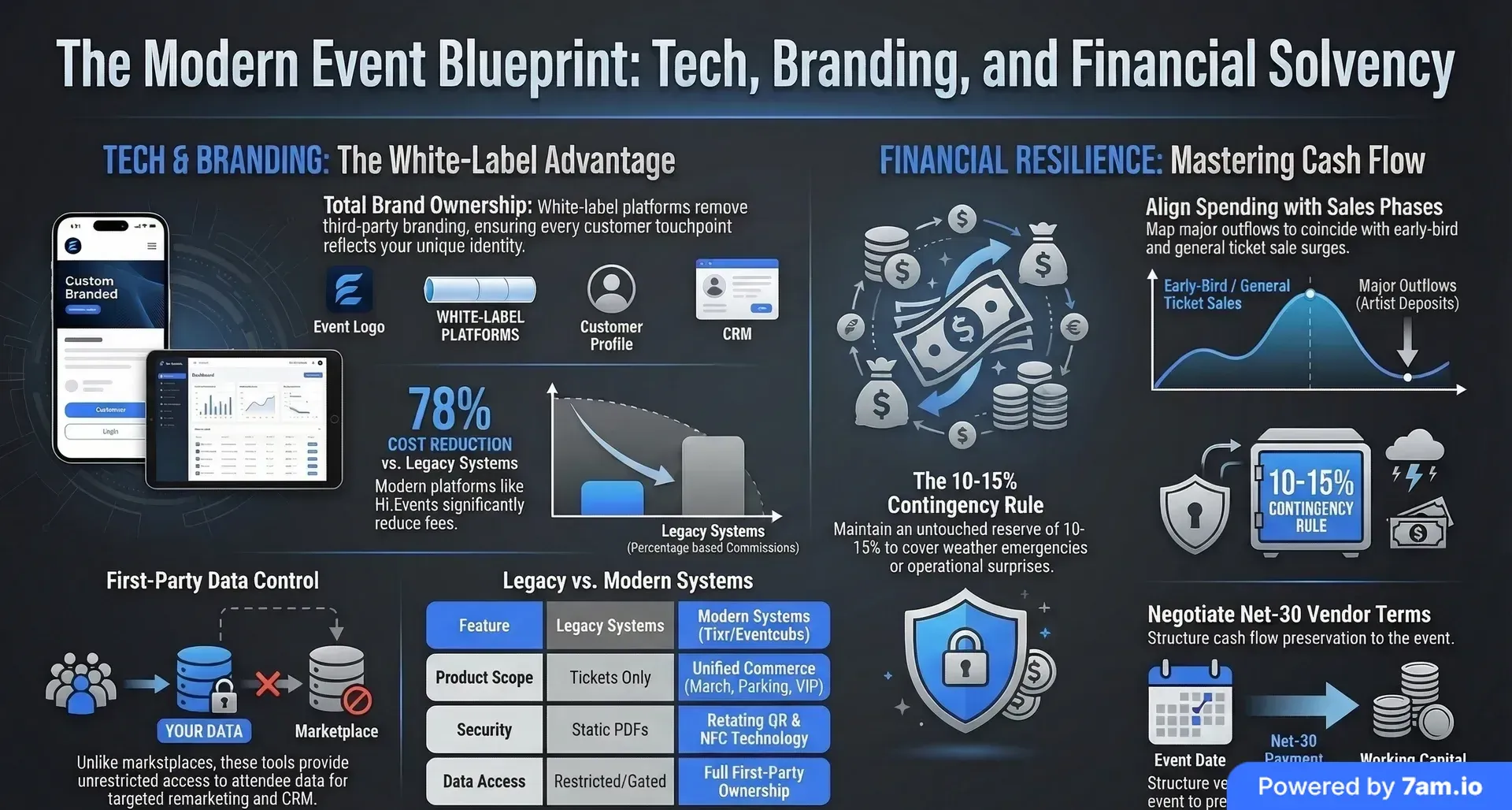
White-label ticketing stops being optional at three inflection points.
1. You're running 3+ events per year. At this frequency, you're building an audience, not just selling tickets to one-off events. Every event is an opportunity to deepen the relationship with past attendees through remarketing, loyalty pricing, and personalised communication. Without data ownership, each event starts from scratch. That means you're spending money to reach the same people who were already in the room six months ago.
2. Your production budget exceeds $10,000. At this investment level, cash flow timing becomes material. A 2-4 week payout delay on $50,000 in ticket sales creates real financial pressure. Instant payouts let you fund production from ticket revenue instead of bridging loans.
3. You're investing in brand building. If you're spending on social media, content marketing, or paid advertising to build your event brand, sending traffic to a marketplace domain undermines that investment. Every click to eventbrite.com/your-event builds Eventbrite's SEO authority and brand equity. Not yours.
The cost of switching is almost always lower than organisers expect. Most white-label platforms offer migration support, and the transition can happen between events with minimal disruption.
When tickets live on eventbrite.com, every marketing dollar you spend drives traffic to Eventbrite's domain. You build their SEO authority, their retargeting audience, and their brand recognition.
SEO impact: Search engines attribute domain authority to the domain that hosts the content. If your event page ranks on Google, that ranking benefit goes to eventbrite.com. Not your website. Over years of events, you've built zero SEO equity on your own domain.
Retargeting impact: Marketplace checkout pages run the platform's tracking pixels, not yours. You can't retarget people who visited your ticket page but didn't purchase. That's the highest-intent audience segment, gone, because you don't own the checkout experience.
Brand consistency: A customer who clicks an Instagram ad, lands on your website, and then gets redirected to a marketplace checkout experiences a jarring brand break. Every redirect reduces conversion rates. A journey from ad to your website to your branded checkout to your confirmation email builds trust and converts better.
For NZ event organisers building a regional brand, domain ownership is particularly important. Local search queries like "festivals in Auckland" or "concerts in Wellington" should build your website's authority. Not a US-based marketplace's.
The visible cost of marketplace ticketing is the per-ticket fee, typically 3-8% plus a fixed amount. The invisible costs are far larger.
1. Customer acquisition cost inflation. Without remarketing data, you pay full price to acquire the same customer for every event. An email to a past attendee costs almost nothing. A Facebook ad to reach them again costs $2-8 per click. Multiply by thousands of repeat attendees over years, and the lost remarketing value dwarfs platform fees.
2. Competitor exposure. Marketplace platforms actively promote competing events to your audience. After someone buys a ticket to your festival, the marketplace shows them "similar events," including your direct competitors. You're paying the platform to help your competition. Let that sink in.
3. Analytics blind spots. Marketplace platforms provide basic sales data but not the deep analytics that drive pricing optimisation. Without access to purchase timing, abandoned cart data, referral sources, and price sensitivity signals, you're making pricing decisions with incomplete information.
4. Contract dependency. Once your audience is trained to buy on a specific marketplace, switching platforms means re-educating thousands of customers. The longer you stay, the higher the switching cost. That's by design.
Most organisers look at ticket sales and call it a day. That's not enough. Track these five metrics to understand whether your ticketing platform is helping or quietly bleeding you dry:
Your ticketing platform controls your cash flow, your customer relationships, your brand identity, and your marketing effectiveness. Every event sold through a marketplace is an event where someone else owns the audience, delays your revenue, and promotes your competitors.
The organisers who build sustainable, profitable event businesses treat ticketing as infrastructure, not a commodity. Audit your current platform against the questions in this guide, calculate the hidden costs, and make the switch before the compound cost gets any higher. Organisers who sell 70% of tickets before announcing a lineup can only do it because they own their ticketing infrastructure.
Start selling on your own terms with 7am with instant payouts, full data ownership, and your brand on every ticket.
Explore More
View All